Pharmaceutical speaker training is how a drug company prepares a doctor or other healthcare professional to present at its promotional speaker programs. Training covers the approved slides, what the speaker can and can’t say, and how to handle questions. It matters because the company is accountable for what its speakers say.
The PhRMA Code puts it plainly: speaker training is “an essential activity because the FDA holds companies accountable” for speakers’ presentations. A speaker who goes off-script, answers an off-label question the wrong way, or skips the safety information creates a problem for the company, not just for the speaker.
This guide covers who needs training, what it should include, how to run it and document it, and when speakers can be paid for their time.
Who needs pharmaceutical speaker training
- New speakers, before their first program
- Existing speakers getting a new or updated deck, for example after a label change, a new indication or new safety information
- All speakers, on a regular refresher cycle that your company sets
- Speakers flagged in monitoring, for example after going off-script
When new clinical data comes out between training cycles, a shorter briefing may be enough. See our guide to briefing speakers on new clinical data.
What pharmaceutical speaker training should cover
| Topic | What the speaker needs to know |
|---|---|
| The product and its approved labeling | Indications, dosing, safety information and the data behind the claims in the deck |
| The approved slide deck | Present it as approved. No added, removed or edited slides |
| FDA rules for promotional talks | Stay consistent with approved labeling, and give safety information the same prominence as benefits |
| Off-label questions | Don’t answer promotionally. Refer the question to the company’s medical information team |
| Adverse events | How to pass on any adverse event they hear about, using the company’s process |
| Program conduct | Who may attend, venue and meal rules, and no alcohol at speaker programs under the PhRMA Code |
| Disclosure | Introduce themselves as speaking on the company’s behalf |
| Contract and payment terms | What they’re paid for, their FMV rate, and that pay has nothing to do with prescribing |
Our checklist for avoiding off-label promotion at speaker events goes deeper on the hardest part: handling questions in the room.
Pharmaceutical speaker bureau training formats
| Format | Works well for | Watch out for |
|---|---|---|
| Live training meeting | Launches and new decks, where speakers need to practice and ask questions | Cost and travel. Venue and meal rules apply |
| Virtual live training | Updates and smaller groups | Confirming who attended, and for how long |
| Self-paced online module | Refreshers and short updates | Making sure speakers actually complete it. Use a short test and an attestation |
Most companies use a mix: live or virtual training for a new deck, and online modules for refreshers.
Can speakers be paid for training?
Sometimes. Under the PhRMA Code, paying speakers for their time at training, and reimbursing reasonable travel, lodging and meals, is appropriate only when all three of these are true:
- They receive extensive training on the company’s product or the specific topic, including FDA requirements for communications.
- The training results in them providing a bona fide service to the company.
- They meet the criteria for a bona fide consulting arrangement.
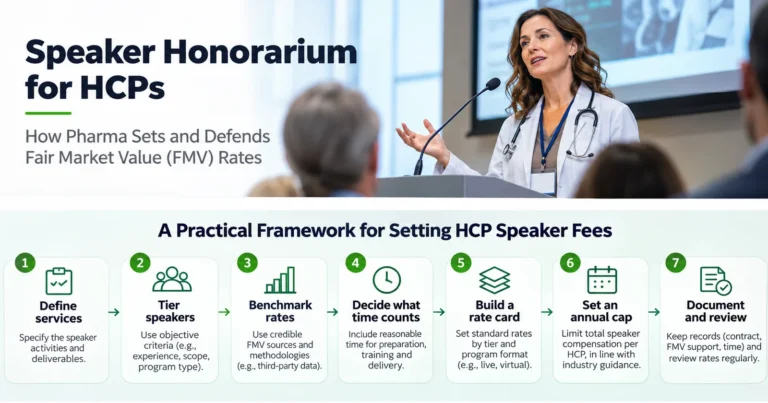
In practice, that means paying only speakers who are contracted and expected to deliver programs, at your FMV rate. See our guide to the speaker honorarium for how to set that rate. Training payments to covered recipients may also be reportable to Open Payments.
How to run pharmaceutical speaker training: 6 steps
1. Get the deck approved first
Training should only start once the slide deck has finished medical, legal and regulatory review. Training speakers on a draft means retraining them later. Our guide to managing speaker slide decks covers how a deck moves from review to the podium.
2. Build the training around the deck
Walk through every slide: what it says, the data behind it, and the likely questions. Include the safety information and how to present it.
3. Practice the hard questions
Role-play off-label questions, competitor questions and questions about unpublished data. Speakers learn the refer-to-medical-information response far better by practicing it than by reading it.
4. Test and get an attestation
Finish with a short knowledge check, and have each speaker sign an attestation that they completed training and will present the deck as approved.
5. Record it against each speaker
Keep the training date, deck version, test result and attestation in each speaker’s record. Block bookings for anyone whose training is missing or out of date. Our guide to HCP engagement workflow automation shows how to do that automatically.
6. Monitor programs and retrain when needed
The PhRMA Code expects companies to periodically monitor speaker programs for compliance with FDA requirements. Attend a sample of programs live or virtually, review attendee feedback, and retrain speakers who drift from the deck.
Pharmaceutical speaker training checklist
- Deck approved by medical, legal and regulatory review
- Training content covering labeling, safety, off-label questions, adverse events and program rules
- A knowledge check and signed attestation for each speaker
- Training records tied to each speaker and deck version
- No bookings until training is complete and current
- Retraining when the label, deck or safety information changes
- Training pay only when the PhRMA Code conditions are met, at FMV
- A program monitoring plan
How ZHM handles speaker training
Our speaker bureau management team organizes speaker training on your approved deck, collects attestations, and keeps training records for every speaker. The Zvent.ai HCP engagement platform holds those records with each speaker’s profile, so only trained speakers get booked. For launch meetings and larger speaker training events, our pharmaceutical event management team handles the logistics. For the wider compliance picture, see our HCP compliance guide.
Training speakers for a launch? Talk to ZHM.
FAQ
What is pharmaceutical speaker training?
It’s training that prepares healthcare professionals to present at a drug company’s promotional speaker programs. It covers the approved deck, the product’s labeling and safety information, and how to handle questions within FDA rules.
Why is speaker training required?
The PhRMA Code calls it essential because the FDA holds companies accountable for what their speakers say in promotional programs.
How often should speakers be retrained?
Whenever the deck, label or safety information changes, plus a regular refresher cycle set by your company.
Can a speaker change the slides?
No. Promotional speakers should present the deck exactly as approved. Any change has to go back through medical, legal and regulatory review.
Are speakers paid for attending training?
Only when the PhRMA Code conditions are met: extensive training, a bona fide service to the company, and a bona fide consulting arrangement, paid at fair market value.