
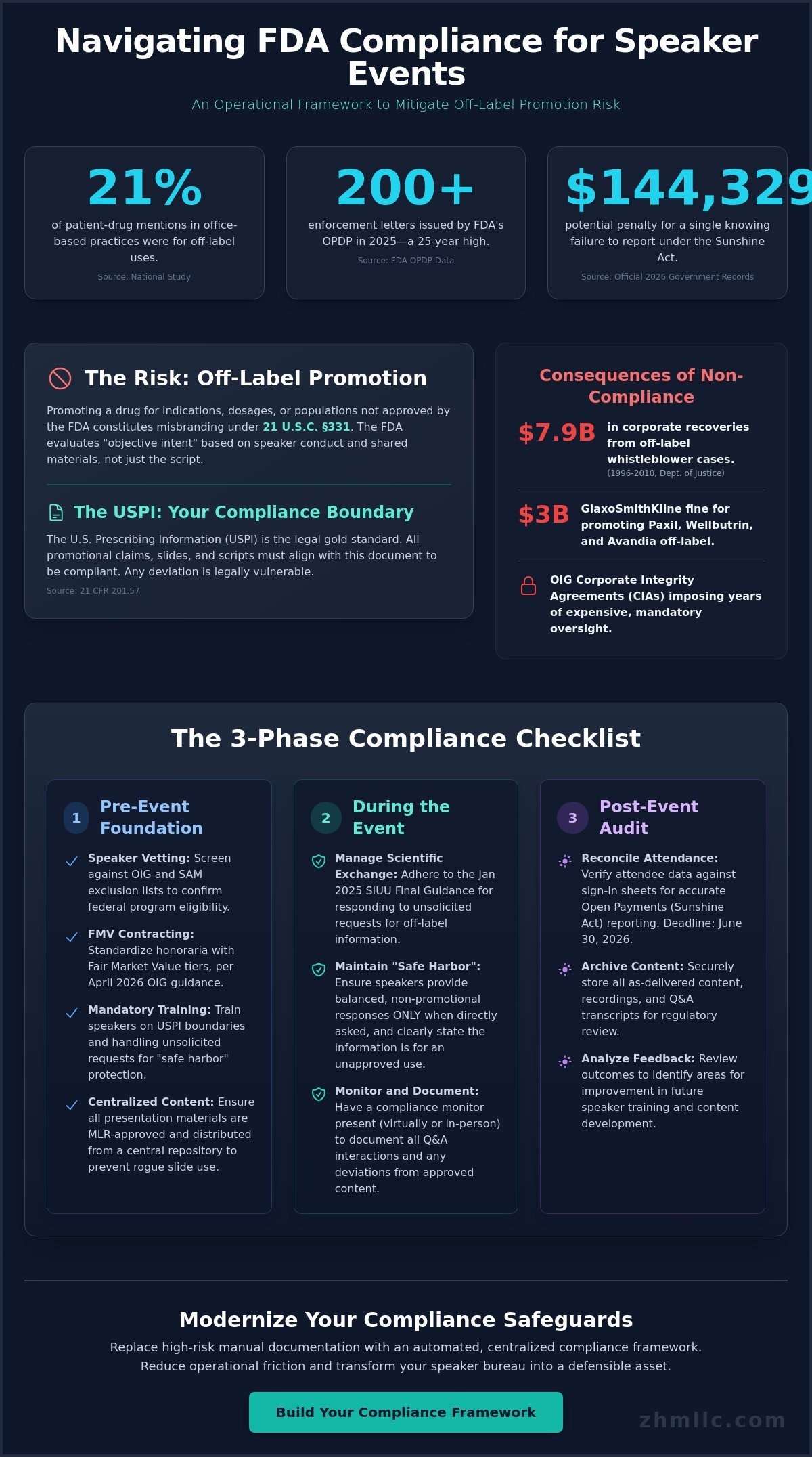
A national study found that approximately 21% of all patient-drug mentions in office-based practices were for off-label uses, creating a high-stakes environment where the line between scientific exchange and illegal promotion is razor-thin. If you’re managing life sciences programs, you’re likely feeling the weight of the FDA’s Office of Prescription Drug Promotion (OPDP) issuing over 200 enforcement letters in 2025, the highest annual total in nearly 25 years. Effectively avoiding off-label promotion in speaker events requires more than just a legal policy; it demands a precise operational workflow that accounts for the January 2025 SIUU final guidance and the April 2026 FDA standards on scientific exchanges.
We understand the stress of managing manual documentation while facing Sunshine Act penalties that, according to official 2026 government records, can reach $144,329 for a single knowing failure to report. This article provides a rigorous operational checklist designed to help your team navigate complex FDA regulations and the latest OIG updates on Fair Market Value (FMV) from April 2026. You’ll gain a repeatable compliance framework that reduces the risk of misbranding charges and ensures efficient Sunshine Act reporting before the June 30, 2026, publication deadline. We’ll walk through the essential steps to transform your speaker bureau from a source of regulatory friction into a centralized, automated asset.
Key Takeaways
- Establish a clear legal foundation by aligning all speaker content with USPI boundaries and 21 U.S.C. §331 to prevent misbranding.
- Implement rigorous speaker vetting and mandatory training on approved indications as the primary defense for avoiding off-label promotion in speaker events.
- Apply the January 2025 SIUU Guidance to manage scientific exchange safely while maintaining “safe harbor” protections for unsolicited requests.
- Streamline post-event audits by reconciling attendance data for Open Payments reporting and archiving all as-delivered content for regulatory review.
- Replace manual documentation with automated workflow triggers and centralized MLR-approved content to eliminate operational friction and the risk of rogue slide use.
Understanding Off-Label Promotion and USPI Boundaries
Off-label promotion occurs when a manufacturer promotes a drug for indications, dosages, or populations not specifically approved by the FDA. While physicians can legally prescribe drugs for unapproved uses, the Federal Food, Drug, and Cosmetic Act under 21 U.S.C. §331 strictly prohibits manufacturers from misbranding products. For life sciences teams, defining off-label use accurately is the first step in avoiding off-label promotion in speaker events.
The FDA assesses compliance through the “Intent” Standard, evaluating the “objective intent” of the firm based on the speaker’s conduct and the materials shared. Regulators look beyond the script. They examine the context of the program and whether the manufacturer’s actions demonstrate a goal of promoting unapproved uses. If a speaker consistently discusses unapproved dosages without a specific, unsolicited prompt, the agency can cite this as evidence of misbranding. This standard makes avoiding off-label promotion in speaker events a matter of behavioral control as much as content review.
The risks aren’t just theoretical. Historical data from the Department of Justice shows that between 1996 and 2010, over 40 whistleblower cases related to off-label promotion resulted in $7.9 billion in corporate recoveries. This includes notable settlements such as the $3 billion fine for GlaxoSmithKline involving Paxil, Wellbutrin, and Avandia. Companies found in violation often end up under OIG Corporate Integrity Agreements (CIAs), which impose years of expensive, mandatory oversight on all commercial activities. These agreements can stifle a product’s launch trajectory and damage a brand’s reputation with healthcare providers (HCPs).
The Role of the U.S. Prescribing Information (USPI)
The USPI is the gold standard for every slide and script. Any claim that falls outside this approved document is legally vulnerable, even if the data is clinically sound. Gray areas often involve specific patient populations or dosing schedules that weren’t the primary focus of clinical trials. According to 21 CFR 201.57, the USPI must summarize the essential scientific information for the drug’s safe and effective use, setting the legal ceiling for all promotional activity.
Enforcement Trends in 2026
In September 2025, the FDA’s Office of Prescription Drug Promotion (OPDP) issued over 200 enforcement letters, signaling a more litigious environment for life sciences teams. Small and mid-sized firms are no longer flying under the radar. These organizations often face heightened scrutiny as they scale their commercial operations. Regulatory bodies now use AI-powered tools to surveil digital and virtual events, ensuring that transcripts from hybrid meetings are just as compliant as traditional dinner programs.
Pre-Event Checklist: Setting the Compliance Foundation
Compliance isn’t a reaction to an audit. It’s a proactive architecture that begins months before the first attendee arrives. For life sciences teams, the pre-event phase is the most critical window for avoiding off-label promotion in speaker events. By establishing rigorous operational guardrails, you eliminate the friction that often leads to regulatory oversight.
Speaker Selection and Contracting Compliance
Every speaker acts as an extension of your firm’s commercial intent. You must vet all potential speakers against the OIG and SAM exclusion lists to ensure they’re eligible to participate in federal healthcare programs. Beyond eligibility, honoraria must be standardized through Fair Market Value (FMV) tiers. On April 23, 2026, the OIG updated its stance to clarify that FMV documentation serves as a primary forensic defense against kickback allegations. Leveraging managed bureau expertise allows you to automate these checks and maintain a defensible record of every contract.
Training is the next pillar. Speakers require mandatory sessions that cover the specific USPI boundaries discussed in the previous section. This training must prepare them to handle audience interactions without drifting into unapproved territory. Familiarizing speakers with the FDA guidance on unsolicited requests ensures they understand how to remain within the “safe harbor” when faced with off-label questions. Clear boundaries protect both the physician and the manufacturer.
Material Review and Version Control
The Medical, Legal, and Regulatory (MLR) review process is your final gatekeeper. Every slide deck must contain “fair balance,” giving equal weight to safety information and clinical benefits. Once approved, these materials must be locked. Unauthorized edits by speakers are a common source of misbranding charges. Implementing digital watermarks or automated version tracking creates a permanent audit trail. This level of precision is vital for avoiding off-label promotion in speaker events and ensuring that only the latest, approved content reaches the audience.
Finally, logistics must reflect the modest nature of professional exchange. Venues and meals must meet established hospitality standards to avoid the appearance of improper influence. If you’re looking to modernize these oversight workflows, contact our team to discuss how automated triggers can simplify your pre-event compliance checklist.
During the Event: Managing Scientific Exchange and SIUU
The live event environment is where theoretical compliance meets operational reality. According to industry survey data, 91% of healthcare professionals (HCPs) prefer remote speaker programs, while 87% favor a hybrid mix of virtual and in-person options. This shift to digital environments makes the real-time management of scientific exchange critical for avoiding off-label promotion in speaker events. Every word spoken in these recorded sessions becomes a permanent part of the compliance record, requiring strict adherence to approved boundaries and the exclusion of promotional bias.
The SIUU Framework for Speaker Programs
On January 6, 2025, the FDA finalized its guidance regarding Scientific Information on Unapproved Uses (SIUU) of approved medical products. This framework provides a safe harbor for disseminating clinical information, provided the communication is truthful and non-misleading. To maintain this protection, firms must include clear disclosures regarding the product’s FDA-approved status and any data limitations. All clinical information shared under this guidance must be scientifically sound and presented in a non-promotional context that prioritizes the educational needs of the HCP.
Managing Unsolicited HCP Questions
Unsolicited requests for off-label information represent a significant risk if not handled with precision. When an HCP initiates a question about an unapproved indication, the speaker must document the inquiry as “unsolicited” to maintain compliance records. Protocol requires that sales representatives remain entirely uninvolved in these specific Q&A segments. All off-label inquiries must be transitioned to Medical Affairs or Medical Science Liaisons (MSLs). This separation is a key component of avoiding off-label promotion in speaker events, as it ensures that commercial stakeholders don’t influence the exchange of unapproved information.
As established in 2026 regulatory updates, the FDA and FTC have merged enforcement efforts to target the commercialization of off-label use. These agencies utilize the FTC Substantiation Standard to audit clinical claims, requiring competent and reliable scientific evidence for all statements made during a program. High-risk events benefit from compliance observers who monitor interactions in real-time. This proactive layer of protection prevents minor verbal deviations from escalating into misbranding charges or OIG enforcement actions.
Post-Event Audit: Documentation and Transparency Reporting
The conclusion of a speaker program marks the beginning of the most critical phase for compliance teams. Data reconciliation isn’t just a clerical task; it’s a legal safeguard. You must compare actual attendance logs against initial invite lists to ensure every interaction is accounted for. This step is foundational to avoiding off-label promotion in speaker events because it validates that only appropriate HCPs were present and that no unauthorized sessions occurred.
Sunshine Act and Open Payments Reconciliation
Accuracy in transparency reporting is mandatory for maintaining your firm’s reputation and avoiding the steep penalties associated with the Sunshine Act. For 2026, the deadline to submit all 2025 Open Payments data to CMS is March 31. Capturing precise National Provider Identifier (NPI) numbers and state license data during check-in prevents reporting errors that lead to physician disputes. Between April 1 and May 15, 2026, physicians will review this data. Any unresolved disputes will be visible in the final public data release on June 30, 2026. Automating the flow from event check-in to your transparency reports eliminates the manual documentation burdens that often hide compliance gaps.
Closing the Compliance Loop
Archiving as-delivered content is a forensic necessity. You must store the exact slide decks used and the full logs of all Q&A sessions. This documentation serves as your primary defense in avoiding off-label promotion in speaker events by proving the speaker adhered to the USPI boundaries. Reviewing these metrics allows you to identify red flags, such as outlier spend or repeat attendees, which might suggest a pattern of improper influence rather than legitimate education.
Documenting corrective actions for any identified deviations is equally important. If a compliance observer notes a minor verbal slip, your records should show the immediate feedback or retraining provided to the speaker. This demonstrates a culture of active compliance rather than passive observation. Maintaining a central source of truth for all program documentation ensures your team stays audit-ready throughout the year.
Honoraria and Final Reconciliations
Honoraria processing must only occur after you verify that the speaker successfully completed the service according to the contract. This prevents kickback perceptions associated with prepayments. A central source of truth integrates your contracting, logistics, and transparency data into a single environment. This integration is the only way to meet the growing demand for real-time audit-readiness in a multi-channel engagement model. To streamline your audit-readiness and automate your data reconciliation, request a consultation with our compliance specialists.
Technology as a Safeguard: Modernizing Oversight
Manual tracking isn’t enough to meet the regulatory demands of 2026. With the FDA now using AI-powered tools to surveil drug advertisements, life sciences teams must adopt similar technology to ensure compliance. Transitioning from fragmented spreadsheets to a centralized digital environment is the most effective way of avoiding off-label promotion in speaker events. Automation removes the operational friction that leads to human error, providing a protective layer against misbranding charges.
Centralizing MLR-approved content ensures that speakers only have access to the latest, approved materials. This prevents the use of “rogue” slides that might contain unapproved data or outdated safety information. By locking presentation decks within a secure platform, you maintain strict version control and a clear audit trail of what was actually presented to HCPs. Real-time budget tracking adds another layer of security, preventing over-spending violations that could trigger OIG scrutiny regarding kickbacks or improper influence. Integrated FMV and transparency reporting ensure that every transfer of value is captured accurately for the March 31, 2026, Open Payments deadline.
The Value of the Zvent.ai Platform
The ZHM LLC Zvent.ai platform integrates contracting, logistics, and compliance into a single ecosystem. This integration ensures that every step of the speaker program, from initial vetting to final honoraria payment, is linked to a specific compliance trigger. Automated reminders for speaker training and certification renewals ensure that no HCP takes the stage without the necessary regulatory preparation. By automating these workflows, you reduce the manual documentation burden on your team while increasing the accuracy of your transparency reports. This centralized approach simplifies the review and dispute period for physicians, which runs from April 1 to May 15, 2026.
Scalability for Emerging Biotech
Lean life sciences teams often face the highest regulatory risk because they lack the massive compliance departments of larger firms. A “pay-as-you-grow” model allows emerging biotech companies to access enterprise-grade oversight without the overhead of a permanent internal infrastructure. This approach reduces the total cost of compliance through operational efficiency and centralized data management. It’s a proactive way to manage the 21% off-label use rate mentioned earlier in this guide without sacrificing speed or innovation. You can view ZHM LLC pricing to see how scalable speaker bureau services can protect your launch trajectory while avoiding off-label promotion in speaker events.
Securing Your Program’s Launch Trajectory
The regulatory environment of 2026 demands a shift from reactive legal reviews to proactive operational excellence. Successfully avoiding off-label promotion in speaker events requires a meticulous blend of USPI alignment, rigorous speaker training, and automated data reconciliation. By centralizing your workflows, you eliminate the manual burdens that often lead to misbranding charges or Sunshine Act penalties. This structured approach ensures that every scientific exchange remains truthful, non-misleading, and fully documented.
Since 1999, ZHM LLC has acted as a protective layer for life sciences teams, providing the industry expertise needed to navigate complex FDA and OIG mandates. Our proprietary Zvent.ai platform offers enterprise-grade compliance specifically designed for lean biotech teams, ensuring your programs remain audit-ready without sacrificing commercial speed. You can transform your speaker bureau into a streamlined, high-performance asset while maintaining total transparency. Whether you’re managing virtual, hybrid, or in-person programs, the right technology ensures every interaction stays within approved boundaries.
Streamline your compliance with Zvent.ai and ZHM LLC and take the stress out of your 2026 event calendar. We’re ready to help you build a defensible, efficient framework for your next program.
Frequently Asked Questions
What is the January 2025 SIUU guidance regarding off-label promotion?
The January 6, 2025, SIUU guidance establishes a safe harbor for firms to share scientific information on unapproved uses of approved medical products. It requires these communications to be truthful, non-misleading, and accompanied by specific disclosures about the product’s FDA-approved status. This framework helps teams in avoiding off-label promotion in speaker events by providing a clear legal structure for disseminating clinical data without crossing into misbranding.
Can a speaker answer an off-label question during a promotional program?
Speakers can only answer off-label questions if they’re clearly unsolicited and the response is transitioned to Medical Affairs or a Medical Science Liaison. Commercial representatives and sales staff aren’t allowed to participate in these specific Q&A segments. This separation is essential for maintaining the “safe harbor” protections outlined in current FDA guidance and preventing the perception of promotional intent during a commercial program.
What are the penalties for off-label marketing under the Sunshine Act?
Sunshine Act penalties in 2026 are substantial, with non-knowing failures reaching $14,432 per payment. Knowing failures to report transfers of value can result in fines of up to $144,329 per instance. Accurate reporting of meals, travel, and honoraria is vital to avoid these financial risks and maintain compliance with CMS Open Payments requirements before the June 30 publication deadline.
How does the FDA distinguish between scientific exchange and promotion?
The FDA distinguishes between scientific exchange and promotion primarily through the objective intent of the firm and the speaker’s conduct. According to the April 2026 guidance on “Scientific Exchanges and the Commercial Interface,” regulators look at whether the interaction was designed to educate or to drive unapproved sales. Factors like the venue, the audience, and the presence of sales staff influence this determination during an audit.
What is the role of a compliance observer at a pharmaceutical speaker event?
A compliance observer monitors live programs to ensure that speakers adhere to the USPI and handle audience questions within legal boundaries. They act as a real-time safeguard against verbal slips that could lead to enforcement actions. Their presence is particularly important at high-risk events involving new products or complex clinical data where the line between education and promotion is often scrutinized.
How should a company document an unsolicited request for off-label information?
Companies should document the specific nature of the request, the identity of the HCP, and the fact that it wasn’t prompted by the speaker or sales staff. This record must show the request was immediately referred to Medical Affairs for a response. Automated platforms help ensure this documentation is captured consistently and remains audit-ready for any future inquiries from the FDA’s Office of Prescription Drug Promotion.
Is virtual speaker program compliance different from in-person events?
Compliance standards remain identical for virtual and in-person events, though the digital nature of virtual programs creates a permanent record for regulators. Since 91% of HCPs prefer remote options, firms must use centralized content management to lock slide decks and prevent unauthorized edits. Digital monitoring tools and AI-powered surveillance are now a standard part of the FDA’s enforcement toolkit for hybrid engagement models.
Why is FMV (Fair Market Value) critical for avoiding off-label scrutiny?
FMV is critical because it serves as a forensic defense against allegations that payments to speakers are actually kickbacks for off-label prescribing. The OIG’s April 23, 2026, update emphasizes that meticulously documented FMV tiers prove a firm’s payments are for legitimate services. This documentation is a cornerstone for avoiding off-label promotion in speaker events by establishing a defensible commercial foundation that resists regulatory challenges.