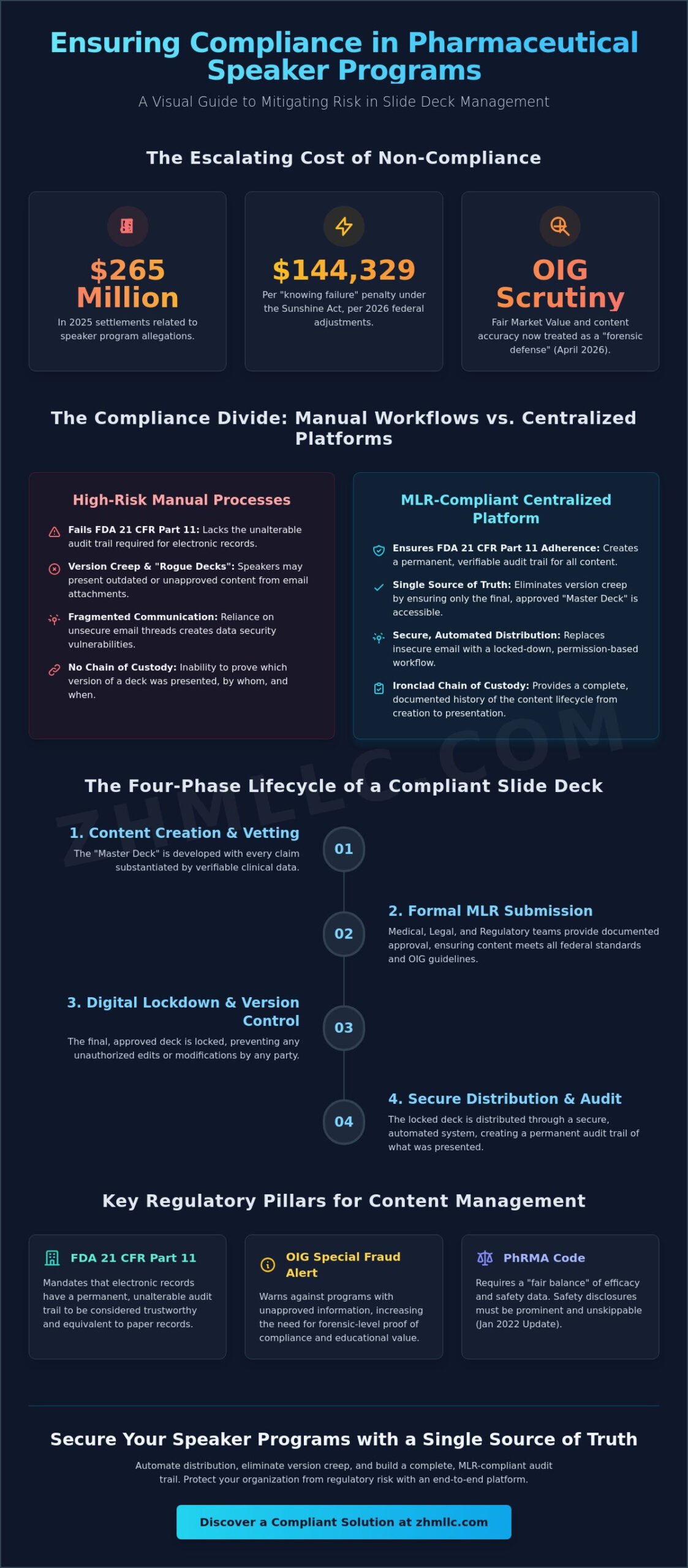
In 2025, settlements from pharmaceutical companies related to speaker program allegations reached a staggering $265 million. This figure highlights that managing speaker content and slide decks is now a high-stakes compliance necessity rather than a simple administrative chore. You likely deal with the constant anxiety of version creep or the risk of a speaker presenting off-label content from an outdated email attachment. It’s exhausting to manage these workflows manually while facing the threat of Sunshine Act penalties, which can now reach $144,329 per knowing failure according to 2026 federal adjustments.
We’ll show you how to establish a rigorous, MLR-compliant chain of custody that eliminates operational friction and ensures a “single source of truth” for every presentation. With the Office of Inspector General (OIG) redefining Fair Market Value as a forensic defense on April 23, 2026, the need for precision has never been greater. This article provides a clear roadmap for automating your distribution and building a full audit trail to protect your program’s integrity and your team’s peace of mind.
Key Takeaways
- Understand why generic file-sharing tools don’t satisfy the FDA 21 CFR Part 11 requirements for digital content and chain of custody.
- Learn how a centralized repository for managing speaker content and slide decks eliminates version creep and ensures only approved materials reach the stage.
- Master the lifecycle of a compliant deck by documenting every claim and citation through a structured internal vetting and MLR submission process.
- Establish a mandatory content cut-off to replace fragmented email threads with a secure, automated distribution workflow.
- See how integrating slide management into an end-to-end speaker bureau platform provides a protective layer against regulatory risk and operational friction.
Beyond the Podium: Why Pharma Slide Management Requires Regulatory Precision
For life sciences organizations, a presentation is never just a collection of slides; it’s a regulated medical communication. In 2025, settlements related to speaker program allegations exceeded $265 million, a figure that underscores the severe consequences of oversight failures. Effective management of these programs requires more than just logistical coordination. It demands a strict adherence to FDA 21 CFR Part 11, which establishes the criteria under which electronic records and signatures are considered trustworthy and equivalent to paper records. When managing speaker content and slide decks, your system must provide a permanent, unalterable audit trail that proves exactly what was presented, by whom, and when.
Generic file-sharing platforms like Dropbox or Box often fail the “Chain of Custody” test required in a medical-legal-regulatory (MLR) environment. These tools lack the granular version control and permission-based lockdowns necessary to prevent unapproved edits. Without a centralized system, teams often rely on unencrypted email threads, creating significant security vulnerabilities for sensitive medical data. This fragmented approach leads to “rogue decks,” where speakers inadvertently use outdated versions containing unverified claims or expired data. These discrepancies don’t just cause confusion; they trigger direct violations of federal transparency standards and internal compliance protocols.
Transitioning to a compliance-first strategy means treating every slide as a potential forensic document. The Office of Inspector General (OIG) redefined Fair Market Value as a “forensic defense” in April 2026, and this same level of scrutiny now applies to the content itself. If your organization can’t prove that a speaker used the most current, approved version of a deck, you’re exposed to regulatory risk that far outweighs the convenience of manual file management.
The Role of MLR Review in Content Lifecycle
The MLR review process is the bedrock of compliant HCP engagement. Every image, chart, and citation must undergo rigorous internal vetting before it reaches a speaker. Once the final regulatory sign-off is granted, the content must be locked. Even “minor edits” made by a speaker at the podium can invalidate the entire approval, as these changes haven’t been screened for legal or medical accuracy. A centralized platform ensures that only the “Master Deck” is accessible, preventing any unauthorized modifications between the review room and the event stage.
Regulatory Oversight and the PhRMA Code
All speaker materials must align with the PhRMA Code on Interactions with Healthcare Professionals, which saw its last major update on January 1, 2022. This code mandates a “fair balance” between efficacy and safety data. If a speaker skips a safety slide or uses a version where the safety data is buried, the program is no longer compliant. Manual processes make it nearly impossible to guarantee this balance across hundreds of simultaneous programs. By integrating pharmaceutical marketing regulations into your digital workflow, you ensure that safety disclosures are prominent and unskippable. This structured approach, supported by the Zvent.ai Platform, provides the protective layer necessary to navigate today’s stringent regulatory landscape with confidence.
The Lifecycle of a Compliant Slide Deck: From MLR Review to Live Execution
Establishing a compliant lifecycle for speaker materials requires a transition from chaotic manual handling to a structured, four-phase workflow. It starts with Phase 1: Content Creation and Internal Vetting. This is where you develop the “Master Deck,” ensuring every claim is backed by clinical data. Phase 2 involves Formal MLR Submission. Here, medical, legal, and regulatory teams document the approval of every citation to ensure the content meets federal standards. This documentation is critical because the OIG Special Fraud Alert on Speaker Programs specifically warns against programs that lack substantive educational value or present unapproved information.
Once the review is complete, the deck enters Phase 3: Digital Lockdown. At this stage, the content is frozen. No speaker, coordinator, or sales rep can modify the slides. This prevents the “minor edits” that often lead to compliance breaches. Finally, Phase 4 is Targeted Distribution. Managing speaker content and slide decks effectively means ensuring that only the assigned speaker for a specific event can access the version approved for that date. This prevents the accidental use of older decks that might not reflect current safety labeling or Fair Market Value methodologies mandated as of January 1, 2026.
Version Control and the “Single Source of Truth”
Manual file management often results in confusing naming conventions like “Final_v3_Approved_NEW.pptx.” This ambiguity is a compliance trap. Centralizing the process of managing speaker content and slide decks within a dedicated platform eliminates the need for email attachments, which are unsecure and difficult to track. Modern systems automate the expiration of outdated decks. If a label change occurs, the platform can immediately revoke access to old materials, ensuring speakers only see what is currently valid. This automation removes the human error associated with manual “delete” requests sent to speakers via email.
Speaker Onboarding and Content Familiarization
A compliant deck is only effective if the speaker presents it accurately. Proper onboarding involves more than just sending a link. It requires documenting that the speaker has received and reviewed the specific MLR-approved materials. With 87% of HCPs now demanding hybrid engagement options, your tracking must be robust across both virtual and physical environments. Using the Zvent.ai Platform, organizers can track exactly when a speaker engages with their training materials. This provides a verifiable record of preparation, which is essential for audit readiness. If you’re looking to streamline your internal approvals, contact our team for a workflow assessment.
Manual Content Handling vs. Centralized Platform Management
Traditional methods of managing speaker content and slide decks rely on a patchwork of email attachments and USB drives. This manual approach creates significant operational friction. Program managers spend hours chasing speakers for the latest files, only to find that the version received doesn’t match the MLR-approved master. Beyond the administrative burden, unencrypted email threads pose a severe security risk for sensitive medical data. Relying on these outdated methods ignores the OIG guidance on physician-vendor relationships, which emphasizes that all promotional activities must be strictly monitored to prevent off-label promotion and ensure ethical standards.
The “Nightmare at the Podium” is a direct result of manual handling. When a speaker arrives with a personal laptop or a corrupted drive, the resulting technical failure disrupts the educational intent of the program. These last-minute crises aren’t just stressful; they’re preventable. Automating these workflows removes human error from the equation. By shifting to a centralized environment, organizations reduce the hours spent on file administration. This allows teams to focus on strategic HCP engagement rather than troubleshooting attachments or verifying version history at the eleventh hour.
Comparing Features: Generic Tools vs. Life Sciences Platforms
Generic event tools or legacy CRM systems often lack the specialized compliance guardrails required for the pharmaceutical sector. While generic platforms offer basic upload functionality, they don’t provide the “white-glove” support necessary for high-profile HCP speakers. You need a system that integrates slide management into the broader event lifecycle. Learn how ZHM LLC’s Zvent.ai platform modernizes pharma speaker programs by replacing manual uploads with a secure, automated chain of custody that bridges the gap between MLR approval and live execution.
The Audit Trail: Proving Compliance to Regulators
In a regulatory audit, a simple verbal confirmation isn’t sufficient evidence. Auditors require a timestamped record showing exactly who accessed which deck and at what time. Centralized platforms generate these reports automatically. This is especially critical as manufacturers prepare for the 2025 data submission to the Open Payments program, due by March 31, 2026. A locked system ensures that content cannot be altered without leaving a digital footprint. This level of precision provides the peace of mind that every presentation delivered is the exact version your legal team approved. It transforms compliance from a reactive scramble into a proactive, automated standard.
5 Steps to Ensure Speakers Present Only Approved Medical Content
While establishing a “Single Source of Truth” is essential for managing speaker content and slide decks, the tactical execution at the event level determines your regulatory safety. Rehearsing a presentation is only valuable if the speaker is practicing with the correct, vetted data. To eliminate the risk of off-label promotion or unapproved claims, your organization should adopt a standardized Five-Step Protocol for every engagement.
- 1. Establish a Mandatory Content Cut-off: Set a hard deadline for all speaker submissions. This ensures that the MLR team has adequate time to review any custom additions before the event date.
- 2. Utilize a Centralized Repository: Use a platform that pushes the latest approved version directly to the stage. This removes the need for speakers to bring their own files on vulnerable USB drives.
- 3. Implement “No-Edit” Permissions: Lock the presentation files once they’re approved. Speakers should have access to view and practice, but the ability to alter slides or data must be restricted to authorized internal personnel.
- 4. Conduct a Technical Run-Through: Perform a full content load and verification 24 to 48 hours before the program. This confirms that all media, charts, and safety disclosures display correctly in the event environment.
- 5. Archive the “As-Presented” Deck: Immediately following the session, archive the exact version used. This creates a forensic record that is vital for compliance reporting and internal audits.
Implementing these steps manually is labor-intensive and prone to oversight. If you’re ready to automate these safeguards, contact us to see how ZHM LLC integrates these steps into a single workflow.
Managing Speaker Notes and Annotations
Speaker notes are a frequently overlooked compliance loophole. If a speaker uses unvetted notes to prompt their delivery, they may inadvertently make off-label claims that aren’t visible on the slides. Every note, annotation, and talk track must undergo the same MLR review as the visual content. Distinguishing between personal cues (e.g., “pause for breath”) and medical claims is vital. Providing “Approved Talk Tracks” alongside the visual deck ensures that the speaker’s narrative remains within the boundaries of the approved labeling and clinical data.
Handling Last-Minute Clinical Data Updates
In the fast-moving pharmaceutical landscape, new clinical data can break just days before a scheduled program. When this happens, you need an “Urgent MLR Review” protocol. A centralized platform like Zvent.ai allows you to perform instant, global updates. Instead of emailing hundreds of speakers to “delete the old file,” you can update the Master Deck in the repository. The new version is automatically pushed to every active program across all territories. This ensures unified messaging and protects the organization from presenting outdated or inaccurate safety information during a critical transition period.
Optimizing Content Workflows with Zvent.ai: The ZHM Advantage
Zvent.ai acts as a protective layer between your organization and the inherent risks of HCP engagement. By integrating managing speaker content and slide decks directly into the program lifecycle, the platform ensures that compliance isn’t a final check but a continuous state. This integration eliminates the manual hand-offs that lead to version creep and regulatory exposure. With the Office of Inspector General emphasizing data-backed compensation models as of April 2026, having a platform that tracks every interaction with forensic precision is no longer optional. It moves your team away from reactive crisis management toward a proactive, solution-oriented strategy.
ZHM LLC provides more than just a digital repository. Our team offers white-glove operational support to manage the complex transitions between MLR approval and live execution. This high-touch service ensures that even last-minute clinical data updates are handled with composed confidence. We understand that a technical failure at the podium is more than a logistical glitch; it’s a threat to your brand’s credibility and compliance standing. By automating the distribution of approved materials, we remove the friction that typically slows down large-scale speaker bureaus.
Why Emerging Pharma Teams Choose Zvent.ai
Emerging biotech and pharmaceutical firms often face the challenge of meeting enterprise-grade compliance standards with limited internal resources. Zvent.ai solves this through a scalable model that allows teams to grow from 10 programs a year to 500 without a corresponding increase in headcount. To support this growth, the Zvent Lite package offers the full-service workflow for the first 10 meetings at no cost. This includes compliance tracking, templates, and up to five user accounts. Explore ZHM LLC’s pricing and service models for growing life sciences firms to see how elite-level management fits your current budget.
Centralized Order: The End of Fragmented Complexity
The shift from fragmented email chains to an automated, auditable environment is a fundamental transformation for your speaker bureau. By centralizing managing speaker content and slide decks, you meet the 91% of HCPs who now prefer remote or hybrid engagement options without sacrificing security. As the March 31, 2026, deadline for Open Payments data submission approaches, the ability to generate instant, accurate reports becomes your greatest operational asset. You’ll no longer spend weeks reconciling spreadsheets to prove compliance. Contact the seasoned consultants at ZHM LLC to streamline your bureau and move your program toward a future of centralized, automated order.
Securing Your Bureau with Centralized Compliance
Transitioning from fragmented email chains to a locked, MLR-compliant repository is the only way to eliminate version creep and regulatory exposure. By establishing a “single source of truth,” your team ensures that every presentation delivered aligns perfectly with approved medical claims and safety disclosures. Effectively managing speaker content and slide decks transforms compliance from a manual burden into an automated standard that protects your organization’s reputation.
ZHM LLC brings decades of experience in pharmaceutical compliance to your bureau through our proprietary Zvent.ai platform. Our system is built specifically for the life sciences, integrating Sunshine Act and Open Payments transparency reporting directly into your content workflow. This provides the forensic defense required to navigate modern regulatory scrutiny with composed confidence. It’s time to replace operational friction with a streamlined, secure environment for your HCP engagements.
Request a Zvent.ai Demo to See Our Compliant Content Workflows in Action. You can protect your program’s integrity while delivering a seamless, professional experience for every speaker.
Frequently Asked Questions
How does slide deck management impact Sunshine Act reporting?
Slide deck management directly supports Sunshine Act reporting by providing a verifiable record of the educational content delivered in exchange for a speaker’s honorarium. Under the Open Payments program, manufacturers must submit data by March 31, 2026, for the previous year. A robust system for managing speaker content and slide decks ensures that every payment is linked to a specific, approved presentation. This documentation is essential for justifying fair market value during a federal audit.
Can speakers use their own laptops to present at pharma speaker programs?
Using personal laptops is strongly discouraged because it bypasses the organization’s chain of custody and increases the risk of technical failure. When speakers use their own devices, there is no guarantee they are presenting the final, MLR-approved version of the deck. A more compliant approach involves using a centralized repository that pushes the authorized content directly to the event hardware. This ensures that only the “Master Deck” is ever viewed by the audience.
What is the best way to handle version control for multi-speaker bureaus?
The most effective way to handle version control is through a centralized, cloud-based platform that acts as the “single source of truth.” This eliminates the risk of “version creep” where different speakers use various iterations of a presentation. By managing speaker content and slide decks through a unified system, administrators can instantly push updates or revoke access to outdated materials across the entire bureau. This ensures unified messaging and full regulatory alignment for every program.
How long should presentation decks be archived for regulatory compliance?
Pharmaceutical companies should archive presentation decks for at least six to ten years, depending on specific state and federal requirements. This duration aligns with the statute of limitations for many healthcare fraud and abuse investigations. Maintaining an unalterable, as-presented archive is critical for demonstrating compliance to regulators like the HHS-OIG. A centralized platform automates this process by capturing a forensic snapshot of the exact slides used at each individual event.
What happens if a speaker presents unapproved content during a live event?
If a speaker presents unapproved content, the organization faces significant regulatory risk, including potential FDA warning letters or Department of Justice investigations. In 2025, settlements related to such allegations exceeded $265 million. The company must immediately document the incident, assess the impact of the off-label or unapproved claims, and implement corrective actions. Utilizing a locked system that prevents unauthorized edits is the primary defense against these high-cost compliance failures.
How can I automate the distribution of slide decks to remote speakers?
You can automate distribution by utilizing a platform that manages user permissions and pushes content based on event assignments. Instead of manual email attachments, the system grants the speaker secure access to the approved deck once their contract is executed and training is complete. This ensures the speaker receives the correct materials without human intervention. It reduces the risk of administrative errors and providing a clear audit trail for the distribution process.
Is it compliant to use cloud-based tools like Google Slides for pharma programs?
Generic cloud-based tools like Google Slides often fall short of the strict compliance standards required in the pharmaceutical sector. These platforms typically lack the unalterable audit trails and digital signature capabilities mandated by FDA 21 CFR Part 11. For a program to be compliant, the content management system must provide granular version control, restricted permissions, and forensic logging. Generic tools are simply not designed to offer these safeguards to life sciences organizations.
How does Zvent.ai handle the MLR review process for slide decks?
Zvent.ai integrates with your existing internal workflows to ensure that only fully vetted materials are accessible to speakers. The platform acts as a final gatekeeper; once a deck receives regulatory sign-off, it is uploaded and locked within the system. This prevents any further modifications before the presentation. By bridging the gap between MLR approval and live execution, Zvent.ai provides a secure environment where content remains static and compliant throughout its entire lifecycle.