Pharmaceutical event planning is the work of organizing HCP-facing meetings, such as speaker programs, advisory boards, congress symposia and training meetings, so they’re compliant, well run and worth attending. It looks like ordinary event planning from the outside. Underneath, every choice of venue, meal, guest list and slide is shaped by rules that ordinary events don’t face.
This guide walks through how to plan a pharma event from first request to final report. It’s written for brand teams, medical affairs and in-house meeting planners at small and mid-sized companies.
What makes pharmaceutical event planning different
Four things set pharma events apart:
- Every event needs a clear educational or business purpose. The OIG’s 2020 Special Fraud Alert is skeptical of speaker programs with little real educational value.
- Content must be approved. Slides and materials go through medical, legal and regulatory review before anyone presents them.
- Venues and meals are restricted. Many companies follow the voluntary PhRMA Code, which calls for modest venues and no alcohol at speaker programs.
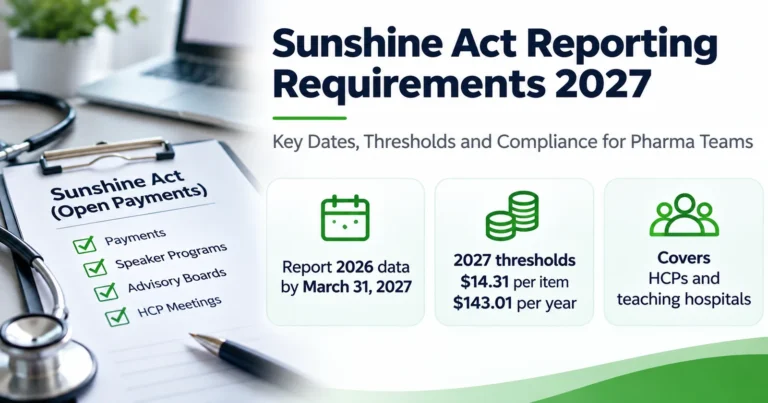
- Spending is public. Applicable payments and transfers of value to covered recipients must be reported to CMS Open Payments, subject to its rules, thresholds and exclusions. Speaker fees, meals, travel and lodging may all need to be captured under the right payment category. Your compliance team decides which transactions are reportable.
Get these right and the rest is good event planning. Get them wrong and a dinner can become a compliance problem.
Common types of pharma events
| Event | Who attends | What to watch |
|---|---|---|
| Speaker program (dinner, in-office, virtual or hybrid) | HCPs who would benefit from the education | Approved content, a modest venue, and repeat attendance only where there’s a bona fide educational need |
| Advisory board | A small group of paid expert advisors | A real need, fair market value pay, a record of how advice was used |
| Congress symposium or booth | HCPs at a medical meeting | Congress rules and approved materials |
| Speaker training meeting | Contracted speakers | Training on approved content and FDA rules |
| Internal or investigator meetings | Staff or trial sites | Clear purpose and modest hospitality |
For advisory boards, see our guide to pharma advisory boards. For virtual and hybrid formats, see our virtual program best practices.
Pharmaceutical event planning, step by step
- Confirm the purpose and get approval. Write down why the event exists, who it’s for and what attendees should learn. Get budget and compliance sign-off before booking anything.
- Choose the format. In person suits deep discussion. Virtual reaches HCPs who can’t travel. Hybrid does both, with more moving parts.
- Pick the date and location. Plan around where your target HCPs actually practice, and avoid clashes with major congresses and holidays.
- Choose a suitable venue. Choose a venue that supports the educational purpose of the program, ideally a private space with good AV. The OIG Special Fraud Alert lists venues “not conducive to the exchange of educational information” as a warning sign. Under the PhRMA Code, which is voluntary, luxury resorts, high-end restaurants and recreational venues are inappropriate for speaker programs, while a modest setting can work when it supports real educational discussion. Follow your own venue policy and any state rules too.
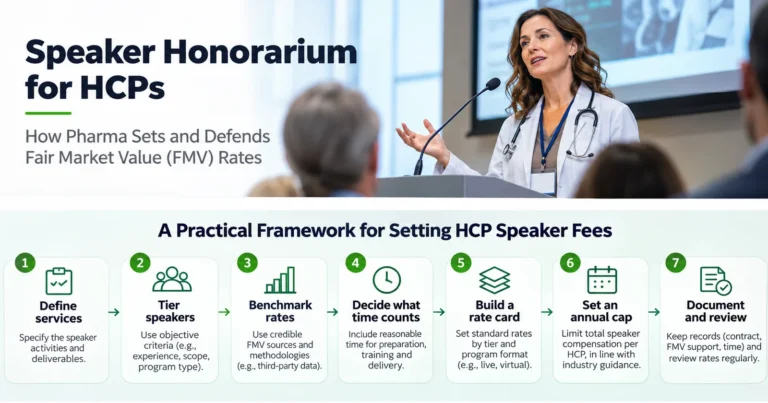
- Contract speakers and vendors. Use written agreements and pay speakers fair market value. See our guides to negotiating speaker agreements and processing honoraria.
- Get content approved and brief the speaker. Use only approved slides, and brief speakers on what to do with unsolicited off-label questions. Our speaker briefing guide covers this.
- Invite the right attendees. Invite HCPs who will benefit from the education. The OIG flags attendees with no legitimate business reason to be there. The PhRMA Code says repeat attendance at a program on the same or substantially the same topic is generally not appropriate unless the attendee has a bona fide educational need. Track attendance by topic so you can spot repeats.
- Set meals and spend limits. Keep meals modest and within your policy caps. Companies that follow the PhRMA Code don’t pay for or provide alcohol at speaker programs. Your own policies, state laws and other industry codes may add requirements; see our state-level compliance roadmap.
- Run the day. Collect sign-ins and confirm attendance, and keep the speaker to the approved deck. Note any issues to report to compliance.
- Reconcile and report. Match receipts, attendees, honoraria and travel to the event record. Record applicable transfers of value for Open Payments under the right category, such as food and beverage, travel and lodging, or speaker compensation (CMS categories). Reporting entities must submit Program Year 2026 data to CMS by March 31, 2027 (CMS). For Program Year 2026, individual payments below $13.82 are generally excluded as long as the recipient’s annual total stays below $138.13. If the annual total goes above that, all applicable payments to that recipient generally have to be reported, and other exclusions may apply. Thresholds change each year: for Program Year 2027 they’re $14.31 and $143.01 (CMS thresholds). See our Sunshine Act reporting guide.
A sample planning timeline
| When | What to do |
|---|---|
| 8+ weeks out | Purpose, budget and approval; format; date and region |
| 6 weeks out | Venue booked; speaker contracted; content submitted for review |
| 4 weeks out | Invitations sent; catering and AV confirmed |
| 2 weeks out | Speaker briefed; attendee list checked for eligibility and repeats |
| 1 week out | Final headcount; materials and sign-in ready |
| Event day | Sign-in, run of show, notes for compliance |
| Within 2 weeks after | Reconcile spend, pay speaker, record transfers of value |
These are typical lead times, not rules. Let approval requirements, speaker availability and event complexity set the schedule, not just the event date. Large or hybrid events need longer.
What a pharmaceutical event planner does
A pharmaceutical event planner, sometimes called a medical meeting planner, handles the logistics above while keeping every decision inside compliance rules. Good pharma meeting planners know venue sourcing, meal caps, speaker travel and transparency reporting as well as they know AV and catering.
Small teams often can’t justify a full-time planner. Many use a partner for logistics and keep strategy in-house. Our outsourced vs in-house analysis compares the costs.
If you’d rather hand off the logistics, our pharmaceutical event management team works as an extension of your planners.
Pharmaceutical event planning checklist
Before the event
- Purpose, budget and compliance approval documented
- Venue suits an educational presentation
- Speaker contracted at fair market value
- Slides approved and speaker briefed
- Attendees invited for a legitimate reason; repeats checked
During the event
- Sign-in and attendance recorded
- Speaker stays on approved content
- Meals within caps; no alcohol where PhRMA Code policy applies
- Any issues noted for compliance
After the event
- Invoices, honoraria and travel reconciled
- Applicable transfers of value recorded for Open Payments
- Event documentation filed
Common mistakes
- Booking the venue before approval. Cancellations cost money, and approvals sometimes change the format.
- Treating it like a client dinner. The venue, the meal and the guest list all need a reason.
- Last-minute slide changes. Unapproved changes create compliance risk.
- Loose attendance records. These make reporting slow and repeat attendance hard to spot.
How ZHM helps
ZHM plans and runs speaker programs and HCP meetings for life sciences teams through our pharmaceutical event management service. That covers venue sourcing, speaker contracting, meal cap tracking, reconciliation and transparency reporting. Our speaker bureau management team can run the whole bureau, and Zvent.ai, our HCP engagement platform, keeps approvals, spend and attendance in one place.
For the bigger picture, see our guide to HCP engagement strategies. Or see how Verrica Pharmaceuticals works with us, and try Zvent.ai free.
This article is general information, not legal advice. Talk to your compliance and legal teams about how these rules apply to your programs.
FAQ
What is pharmaceutical event planning?
Pharmaceutical event planning is organizing HCP-facing meetings, like speaker programs, advisory boards and congress events, so they’re compliant, well run and educational.
What does a pharma meeting planner do?
They source venues, book travel, manage catering and AV, track spend against caps, record attendance and support transparency reporting.
How far ahead should you plan a speaker program?
Around eight weeks is common, allowing time for approvals and content review. Larger or hybrid events need longer.
Can you serve alcohol at pharma speaker programs?
Companies that follow the PhRMA Code don’t pay for or provide alcohol at speaker programs. Check your own policy and any state rules.
Are meals at pharma events reported?
Often, yes. Meals for covered recipients are generally reportable to Open Payments as food and beverage, but small amounts below CMS’s annual thresholds can be excluded, and other exclusions apply. Your compliance team should confirm what’s reportable.
Where it usually goes wrong. An event gets approved in one system, the attendee list lives in a spreadsheet, and meal receipts sit in someone’s inbox. When the event closes, the team has to rebuild the record from three places before it can confirm spend and attendance, and that’s often when errors reach the Open Payments report. Keeping approvals, attendance and spend in one record from the start avoids the rebuild.