
In the pharmaceutical sector, a speaker briefing isn’t just an event orientation; it’s a high-stakes, compliance-locked protocol for data synchronization. Since 80% of healthcare professionals prefer peer-led sessions over content produced directly by pharmaceutical companies, your speakers must be perfectly aligned with the approved medical narrative. You’ve likely dealt with the stress of manual onboarding and the fear of a speaker going off-script during a high-profile presentation. Refining your speaker briefing process for pharma events is the only way to ensure that new clinical data is delivered accurately while meeting the strict standards of the PhRMA Code and the OIG.
This guide will help you master a data-driven workflow that transforms speaker training into a standardized, audit-ready asset. We’ll show you how to move away from fragmented processes toward a centralized system that verifies speaker understanding and protects your organization from regulatory risk. You’ll learn how to implement a comprehensive briefing checklist and maintain the precise documentation required for the March 31, 2026, Open Payments reporting deadline.
Key Takeaways
- Learn how to transition from basic logistical onboarding to a scientific briefing model that prioritizes clinical accuracy and regulatory alignment.
- Discover the essential steps for building a “Core Slide Deck” that survives rigorous Legal, Medical, and Regulatory (LMR) review.
- Master a standardized 5-step speaker briefing process for pharma events to ensure every HCP speaker is fully prepared to deliver complex clinical data.
- Implement specific safeguards to prevent speakers from deviating from approved content and maintain compliance with the latest PhRMA Code venue restrictions.
- Find out how to leverage automated platforms like Zvent.ai to eliminate manual burdens and create audit-ready documentation for transparency reporting.
What is a Speaker Briefing Process in the Pharmaceutical Industry?
A speaker briefing process for pharma events is a structured, mandatory training protocol designed to align Health Care Professional (HCP) speakers with approved Prescribing Information (PI) and specific clinical data sets. It’s no longer a simple logistical check-in. In the 2026 regulatory environment, the industry has transitioned from basic onboarding to high-precision scientific briefing. This process ensures that every speaker delivers a message that is accurate, evidence-based, and fully compliant with federal guidelines. It’s the mechanism that transforms a raw slide deck into a protected, verified educational session.
The briefing serves as the foundation for a “bona fide educational program” as defined by the Office of Inspector General (OIG). This distinction is critical. Without a documented briefing, a speaker program can easily be mischaracterized as an improper inducement. By grounding the session in pharmaceutical marketing principles, companies ensure that the exchange of information remains focused on clinical utility rather than promotional hyperbole. A successful briefing process confirms that the speaker understands the “Fair Balance” requirements, ensuring that risk information is presented with the same prominence as clinical benefits.
The Regulatory Necessity of the Briefing
Briefings act as a primary defense against “sham program” allegations. The OIG 2020 Special Fraud Alert highlighted deep skepticism regarding the educational value of many speaker events. To counter this, a robust speaker briefing process for pharma events provides documented proof of a legitimate educational intent. This is especially vital given that the 2026 penalty for a knowing failure to report transfers of value can reach $1 million. When you can prove a speaker was rigorously briefed on new clinical data, you demonstrate that the transfer of value, such as a speaker’s honorarium, was for a genuine service rather than a kickback. It creates a compliance shield that protects both the manufacturer and the HCP.
Briefing vs. Training: Understanding the Scope
It’s important to distinguish between annual compliance training and event-specific briefings. While they’re related, they serve different purposes and require separate documentation trails. General training usually happens once a year and covers broad topics like the PhRMA Code and anti-kickback statutes. In contrast, a briefing is highly specific. You’ll need a full briefing whenever there’s a new clinical data release, a new indication, or when a new speaker joins the bureau.
- Annual Training: Focuses on conduct, gift bans, and reporting thresholds like the 2026 CMS $13.82 per-instance limit.
- Session Briefing: Focuses on the Core Slide Deck, specific study endpoints, and answering off-label questions.
Documentation is the final, non-negotiable step. If a speaker presents updated data without a recorded briefing, the program risks being flagged during an audit. Using centralized platforms like Zvent.ai allows teams to automate this tracking, ensuring that every speaker is verified and every briefing is logged before the first slide is shown.
Designing a Compliant Speaker Briefing for New Clinical Data
Designing a compliant speaker briefing process for pharma events requires a central “Core Slide Deck” that serves as the singular source of truth. This deck isn’t just a visual aid; it’s a legal boundary. Every data point, from primary endpoints to adverse event tables, must undergo rigorous Legal, Medical, and Regulatory (LMR) review before it reaches a speaker. This ensures that the information is not only scientifically accurate but also meets the “Fair Balance” standards required by the FDA. By locking the content early, you eliminate the risk of speakers introducing unapproved claims or outdated statistics during a live session.
The Clinical Data Transfer Protocol
A successful briefing translates complex statistical outputs into a clear, communicable narrative without losing clinical integrity. Speakers must be trained to interpret and explain specific p-values and hazard ratios exactly as they appear in the clinical study report. Data synchronization for 2026 launches is the intentional alignment of clinical evidence with regulatory guardrails to eliminate interpretive variance. By structuring the briefing around these primary endpoints, you prevent speakers from inadvertently overstating efficacy or downplaying safety risks. This precision is vital for maintaining the educational integrity of the program and satisfying the “bona fide educational need” required by the OIG.
LMR Review and Content Locking
The “Global Approved Deck” is the only material a speaker should use. Managing the content pipeline involves a strict “lock” on slides once they pass review. If a speaker provides feedback or requests changes, these must be funneled back through the LMR process rather than being addressed on the fly. This level of control is essential for adhering to the PhRMA Code on Interactions, which emphasizes that speaker programs must meet a documented educational need. If new data is released mid-cycle, the briefing materials must be updated and re-approved before any further events occur.
Addressing off-label questions is a critical risk-mitigation step in the speaker briefing process for pharma events. You must explicitly instruct speakers to redirect any off-label inquiries to the company’s Medical Affairs department. This protects the speaker and the company from allegations of promoting unapproved uses. Additionally, any time spent in these briefings must be compensated according to documented Fair Market Value (FMV) rates. This prevents the briefing from appearing as an improper payment, particularly as federal agencies continue to scrutinize speaker compensation models. If your team needs assistance navigating these complex regulatory requirements, you can connect with our compliance experts to discuss managed bureau solutions.
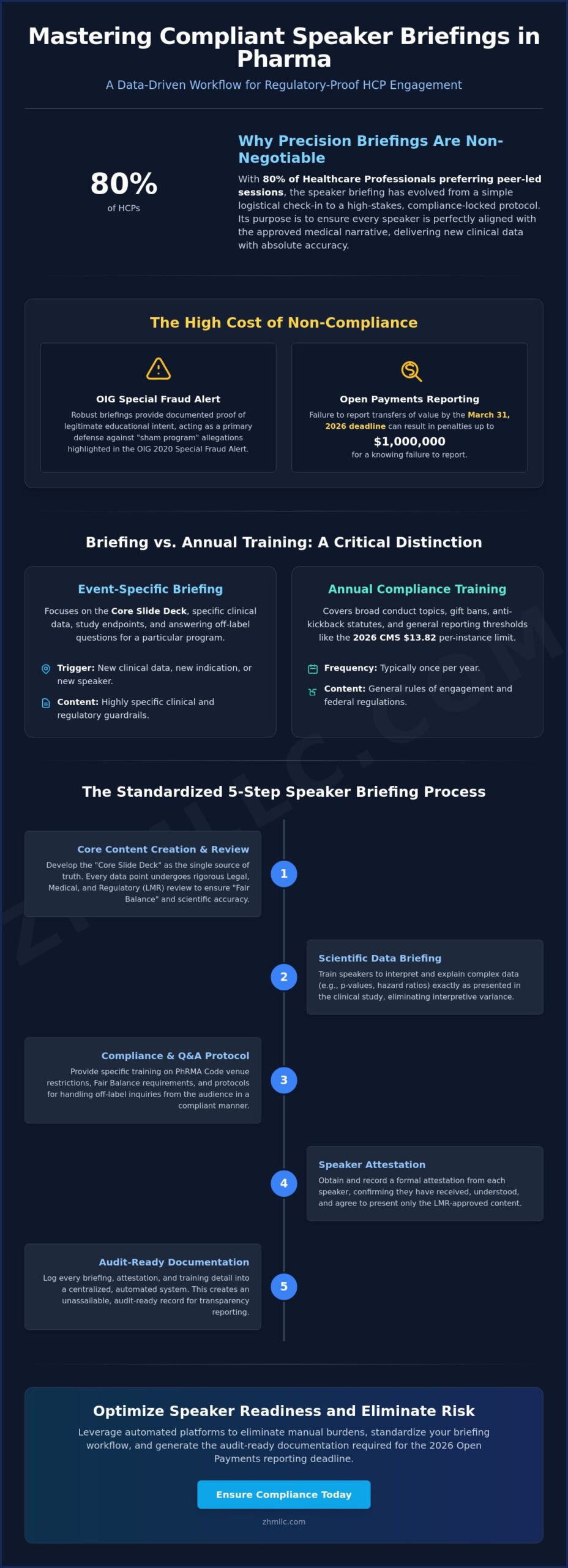
A 5-Step Speaker Briefing Process for Pharma Events
Executing a speaker briefing process for pharma events requires a methodical approach to ensure no regulatory details are missed. It’s not enough to simply email a slide deck; you must build a verifiable trail of education and agreement. This 5-step workflow centralizes every touchpoint, from the initial contract to the final payment, reducing the manual burden on your internal teams while protecting your organization from compliance risks.
Step 1 & 2: Preparation and Pre-Work
The process begins with rigorous selection and contracting. You must verify speaker eligibility through debarment checks against official government lists to ensure the HCP isn’t excluded from federal healthcare programs. Utilizing compliant platforms like Zvent.ai allows you to automate these checks during the contracting phase, creating a seamless transition into the briefing. Once the contract is finalized, you move to the distribution of pre-read materials. These include the full Prescribing Information and the LMR-approved core deck. To maintain security, use digital portals that distribute secure, watermarked materials. It’s vital to set clear expectations for speaker preparation time so they understand the scientific depth required before the live session occurs.
Step 3 & 4: Execution and Verification
The actual briefing session is typically led by Medical Affairs to maintain a clear separation from commercial influence. While didactic sessions are common, interactive formats often lead to higher data retention and better speaker engagement. During the session, you should implement a “Knowledge Check” using targeted quizzes. This verifies that the speaker accurately interprets the clinical data and understands the safety endpoints. Following the session, the speaker must provide a digital signature for an attestation of understanding. This compliance certification serves as your primary documentation that the HCP received the training and agrees to present only the approved, unedited materials.
Step 5: Closing the Compliance Loop
The final step is the administrative wrap-up and honoraria processing. Once the briefing is certified and the attestation is signed, the system should automatically trigger the payment workflow. This ensures that honoraria are issued promptly and reflect the time spent on the briefing at established Fair Market Value (FMV) rates. Every record, including the briefing date, duration, and the value of the transfer, must be uploaded to your transparency reporting database. This level of detail is essential for meeting the March 31, 2026, Open Payments submission deadline. If you want to streamline these complex workflows, you can Learn more about our Managed Speaker Bureau Services to see how automation removes the friction from your compliance reporting.
Mitigating Risk: Compliance Safeguards in the Briefing Workflow
The primary risk in any speaker program is the potential for a presenter to deviate from approved clinical messaging. A rigorous speaker briefing process for pharma events acts as a critical safeguard against this behavior. By requiring speakers to attest to using only the LMR-approved core deck, companies create a clear line of accountability. If an HCP speaker introduces unapproved data or anecdotal claims, the documented briefing serves as evidence that the company provided the necessary guardrails and instructions to remain within the approved Prescribing Information (PI).
Venue and meal compliance are equally vital. The 2022 PhRMA Code update explicitly states that companies should not provide or pay for alcohol at speaker programs. Additionally, the setting must be conducive to education, which excludes luxury resorts and high-end restaurants. During the briefing itself, whether virtual or in-person, you must adhere to “modest meal” limits. For the 2026 reporting cycle, any transfer of value exceeding $13.82 per instance must be documented and reported to the CMS Open Payments database. Tracking the exact “Time Spent” during these briefings is non-negotiable for Sunshine Act accuracy, as this time is calculated into the speaker’s total compensation.
PhRMA Code and OIG Alignment
Adherence to the 2022 PhRMA Code on Interactions with Health Care Professionals is a benchmark for ethical conduct. Federal regulators use this code to determine if a program meets a “bona fide educational need.” To pass the “Bona Fide Need” test, you must document why this specific speaker requires this specific briefing on new clinical data. This prevents the briefing from being viewed as an improper inducement to prescribe. Given that penalties for non-knowing reporting failures can reach $14,432 per payment in 2026, the stakes for precision have never been higher.
Technology as a Compliance Shield
Manual tracking is no longer sufficient to manage the complexities of modern speaker bureaus. Technology like the Zvent.ai platform provides a centralized environment where every touchpoint is recorded for audit readiness. The system generates automated alerts for Fair Market Value (FMV) cap violations or expired contracts before they become a liability. By centralizing all briefing recordings and attestations, you ensure that your team is prepared for any future DOJ or OIG inquiries. This proactive approach eliminates the friction of fragmented documentation and provides a clear path to the March 31, 2026, data submission deadline. To ensure your bureau operations meet these rigorous standards, you can contact our compliance experts for a full workflow assessment.
Optimizing Speaker Readiness with ZHM Managed Services
Managing a speaker bureau requires meticulous attention to detail that often exceeds the capacity of internal teams. ZHM LLC delivers white-glove support designed to alleviate this operational friction. By implementing a standardized speaker briefing process for pharma events, we ensure your clinical data is handled with precision. Our approach replaces fragmented, manual spreadsheets with a centralized digital infrastructure. This transition doesn’t just save time; it builds a protective layer of compliance around every HCP interaction. It transforms a high-risk administrative burden into a streamlined, strategic asset for your medical affairs strategy.
The Zvent.ai platform automates the logistical hurdles that typically delay speaker readiness. From secure document distribution to automated knowledge checks, every step is integrated into a single workflow. This integration extends to honoraria processing and Sunshine Act reporting. When a speaker completes their briefing and attestation, the system triggers the payment process and logs the data for transparency reporting. This end-to-end visibility is essential for maintaining audit readiness and ensuring that your 2026 CMS submissions are accurate and timely. You gain real-time insights into speaker status, ensuring no program goes live without the necessary certifications.
Scalability for Emerging Biotech
Emerging biotech companies often face the challenge of meeting enterprise-grade compliance standards with limited internal resources. Small teams don’t have the luxury of managing complex bureau logistics manually. ZHM LLC offers a “pay-as-you-grow” model that allows these organizations to scale their speaker programs as their clinical portfolio expands. This approach provides access to sophisticated automation and expert oversight without the overhead of a full-time internal department. You can View our Speaker Bureau Pricing and Models to find a solution that aligns with your current launch stage.
White-Glove Operational Support
We act as a seamless extension of your Medical Affairs department. Our team handles the intricate details of the speaker experience, which is vital for maintaining long-term relationships with Key Opinion Leaders (KOLs). When HCPs encounter a frictionless speaker briefing process for pharma events, they can focus entirely on the scientific data rather than administrative burdens. We manage the scheduling, technical support, and documentation, ensuring that every session meets the “bona fide educational need” required by regulatory bodies. If you’re ready to modernize your bureau operations, you can Contact ZHM LLC to streamline your speaker briefing process and secure your compliance workflow.
Modernizing Your Speaker Bureau for Future Compliance
The evolution of regulatory oversight means that a manual speaker briefing process for pharma events is no longer a viable strategy. You’ve seen how a structured, 5-step workflow transforms training from a logistical hurdle into a robust compliance safeguard. By centralizing slide deck management and automating attestations, you protect your organization from the risks of off-label messaging and allegations of improper inducement. Precision in tracking time and transfers of value is essential to meet the March 31, 2026, Open Payments submission deadline.
ZHM LLC provides the specialized expertise and technology needed to handle these complexities with composed confidence. Our proprietary Zvent.ai compliance engine is specifically designed for lean biotech and mid-market pharma teams that require enterprise-grade security without the operational overhead. We bring deep knowledge in Sunshine Act and Open Payments reporting to every engagement, ensuring your data is accurate and audit-ready. Don’t let manual burdens slow your clinical data dissemination. Streamline Your Speaker Briefings with Zvent.ai to secure your bureau’s future. We’re here to help you lead with confidence.
Frequently Asked Questions
Is a speaker briefing required for every pharmaceutical event?
A briefing isn’t required for every single event if the speaker is already certified on the current data set. However, a new speaker briefing process for pharma events must occur whenever there’s a clinical update, a new indication, or a change in the core slide deck. Documentation of the most recent briefing is essential for proving the educational value of the program during a compliance audit.
Can we pay HCPs for the time they spend in a speaker briefing?
You can pay HCPs for briefing time as long as the rate aligns with Fair Market Value (FMV). This payment should cover only the actual duration of the session. It’s vital to document this as a separate transfer of value from the event honorarium. This transparency ensures you aren’t violating anti-kickback statutes or the PhRMA Code guidelines on interactions.
What are the Sunshine Act reporting requirements for speaker briefings?
All transfers of value related to the briefing, including honoraria and modest meals, must be reported to the CMS Open Payments database. For the 2026 reporting cycle, you’re required to track any payment exceeding $13.82. Accurate tracking of “Time Spent” is necessary to justify the payment amounts. These records must be submitted to the CMS by the March 31, 2026, deadline.
How do I handle a speaker who wants to use their own slides instead of the approved deck?
You must require the speaker to use only the LMR-approved core deck. Allowing a speaker to use their own slides is a significant compliance violation that bypasses regulatory review. The speaker briefing process for pharma events exists specifically to ensure that every presenter adheres to the “Fair Balance” requirements. If a speaker refuses to use the approved materials, they must be removed from the program.
What is the difference between a speaker briefing and a product theater?
A speaker briefing is a preparatory training session for the presenter, while a product theater is the actual educational event where the presenter speaks to an audience. The briefing focuses on data comprehension and compliance guardrails. In contrast, the product theater is the promotional vehicle used to disseminate that data to other healthcare professionals in a commercial or medical setting.
How long should a typical pharma speaker briefing session last?
A typical session lasts between 45 and 90 minutes. The length should be directly proportional to the volume and complexity of the clinical data being presented. If a briefing is excessively long without a clear scientific justification, it may be flagged by auditors as an improper payment. You should always document the start and end times to support your FMV calculations.
Can speaker briefings be conducted virtually under PhRMA Code?
Virtual briefings are permitted and are increasingly common in the industry. The PhRMA Code doesn’t restrict the format of the briefing as long as the setting is conducive to education and lacks extravagant elements. Using a centralized digital platform allows you to record the session and capture the necessary attestations. This provides a clear, audit-ready trail of the training process.
What happens if a speaker fails the knowledge check during the briefing?
A speaker who fails a knowledge check cannot present the clinical data until they demonstrate full comprehension. You should offer a follow-up session to address the specific gaps in their understanding. If the speaker still can’t pass the verification quiz, they shouldn’t be certified for that program. This safeguard prevents inaccurate or unsafe information from being shared with the broader medical community.