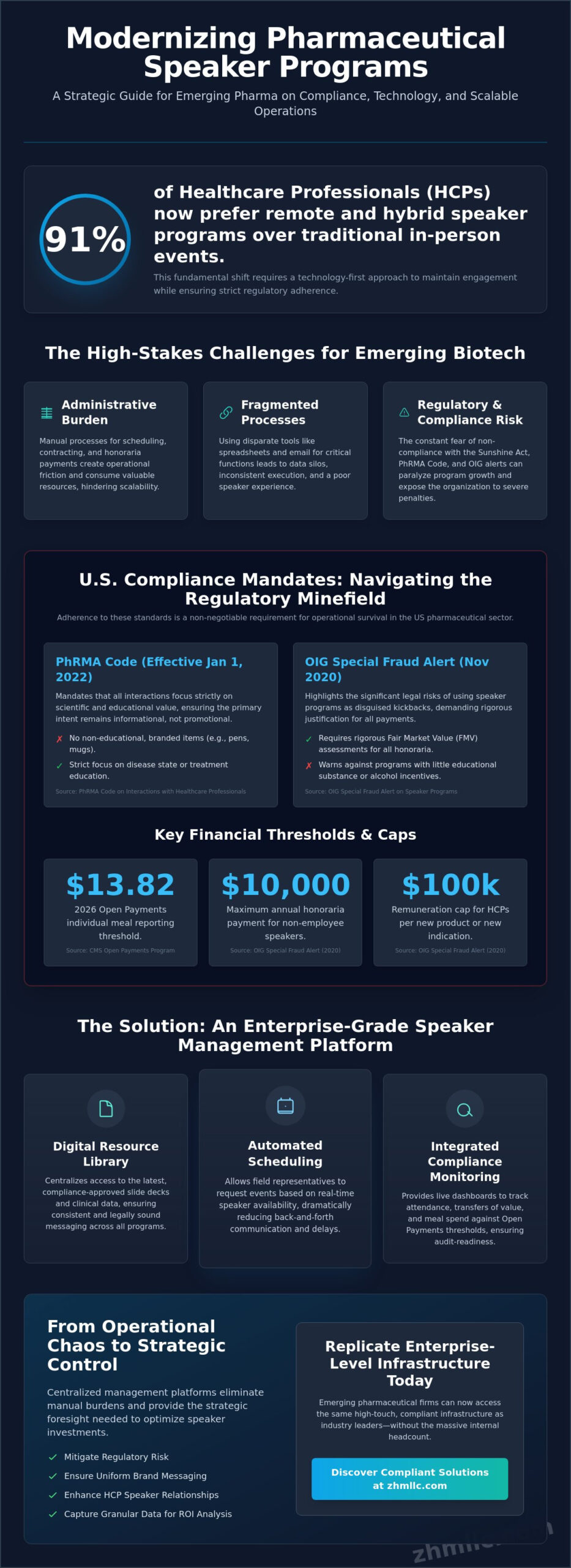
Did you know that 91% of healthcare professionals now prefer remote speaker programs over traditional in-person events? While this shift offers greater reach, managing a sophisticated operation like the abbvie speakers bureau requires navigating a minefield of regulatory hurdles, from the 2022 PhRMA Code updates to the 2026 Open Payments reporting threshold of $13.82 for individual meals. For lean biotech teams, the administrative burden of fragmented contracting and the constant fear of Sunshine Act non-compliance often feels overwhelming. You likely agree that maintaining a high-touch speaker experience shouldn’t require a massive internal team or a manual spreadsheet for every honorarium payment.
This article promises to show you how to replicate enterprise-level infrastructure through modular, tech-enabled management platforms. We’ll explore the essential components of a successful speaker portal, identify ways to automate compliance reporting, and demonstrate how to eliminate manual burdens while staying strictly within US regulatory guidelines. By the end, you’ll understand how to transform a fragmented process into a centralized, data-driven engine that protects your organization from operational friction and regulatory risk.
Key Takeaways
- Analyze the centralized operational framework of the abbvie speakers bureau to understand how enterprise-level platforms manage complex HCP educational programming.
- Identify critical compliance benchmarks, including the PhRMA Code and the 2020 OIG Special Fraud Alert, to ensure your programs meet federal standards.
- Explore the shift toward virtual and hybrid event models that cater to the 91% of healthcare professionals who now prefer remote engagement.
- Discover how emerging pharmaceutical firms can replicate major bureau infrastructure using scalable technology like Zvent.ai and specialized managed services.
What is the AbbVie Speakers Bureau and How Does it Function?
The abbvie speakers bureau is a centralized operational framework designed to facilitate peer-to-peer educational programs and promotional events. It functions as a bridge between the pharmaceutical manufacturer and healthcare professionals (HCPs), ensuring that scientific exchange and brand awareness occur within a highly controlled environment. These bureaus are foundational to modern Pharmaceutical Marketing Practices, as they allow Key Opinion Leaders (KOLs) to share clinical data and treatment protocols with their peers. By centralizing these interactions, the organization maintains a precise protective layer against regulatory risk while driving educational objectives.
Execution at this scale requires sophisticated coordination. Large-scale bureaus often utilize third-party vendors like Medforce or Propel Health to manage the logistical heavy lifting. These partners ensure that every event, whether a local dinner program or a national broadcast, adheres to strict corporate standards. The primary goal is to streamline the speaker journey, moving an HCP from initial contracting through to honoraria payment with minimal administrative friction. This centralized approach replaces fragmented manual processes with a unified digital experience that prioritizes clarity and compliance.
Core Components of an Enterprise Speaker Portal
A successful portal provides a digital resource library where speakers access only the latest, compliance-approved slide decks and clinical data. This ensures messaging remains consistent and legally sound. Automated scheduling modules allow field representatives to request events based on real-time speaker availability, reducing back-and-forth communication. Integrated compliance dashboards provide the home office with live monitoring capabilities. These systems track everything from attendance to meal spend against the 2026 Open Payments individual threshold of $13.82, ensuring that no detail is overlooked during the reporting cycle.
The Strategic Value of Centralized Bureau Management
Centralization eliminates the operational chaos that often plagues lean teams trying to mimic the abbvie speakers bureau model. It ensures that every program across the country delivers a uniform message, which is critical for maintaining brand integrity. By reducing the manual burden on high-value HCP speakers, the organization fosters stronger professional relationships built on reliability. Beyond logistics, these systems capture granular data for impact analysis. Organizations can track ROI by correlating program attendance with shifts in prescribing patterns, providing the strategic foresight needed to optimize future speaker investments. While enterprise giants have long dominated this space, modular platforms like Zvent.ai now allow emerging firms to replicate this high-touch infrastructure without a massive internal headcount.
Compliance Standards for US Pharmaceutical Speaker Programs
Compliance is not a luxury in the pharmaceutical sector. It’s a foundational requirement for operational survival. For organizations modeling their operations after the abbvie speakers bureau, adherence to the PhRMA Code on Interactions with Healthcare Professionals is the first step. The code, last updated in August 2021 and effective since January 1, 2022, prohibits providing non-educational items like pens or mugs. It mandates that all interactions focus strictly on disease or treatment education. This ensures that the primary intent of every engagement remains scientific rather than promotional.
The legal stakes rose significantly with the OIG Special Fraud Alert issued in 2020. This document highlights the risks of using speaker programs as disguised kickbacks. To mitigate this risk, companies must perform rigorous Fair Market Value (FMV) assessments for all honoraria. Non-employee speakers are currently limited to a maximum payment of $10,000. Additionally, a $100,000 remuneration cap applies to each new product or indication. These limits prevent the excessive financial incentives that often trigger federal investigations.
Transparency is equally critical for maintaining a defensible bureau. Under the Sunshine Act, the CMS Open Payments program requires meticulous tracking of all transfers of value. For the 2026 calendar year, any meal provided to an HCP costing $13.82 or more must be tracked. If annual aggregate payments to a single recipient exceed $138.13, every transaction must be reported regardless of size. The deadline for submitting 2025 data to the Open Payments program is March 31, 2026. Failing to meet these standards invites heavy penalties and reputational damage.
Regulatory Frameworks: CMS and OIG Oversight
Oversight bodies prioritize the environment and intent of the educational exchange. High-end restaurants and luxury resorts are no longer acceptable venues. Modest meals are the standard. Pharmaceutical companies should not pay for or provide alcohol in connection with these programs. To avoid kickback allegations, the exchange must be substantive and scientific. Every interaction requires detailed documentation to prove the educational value of the event and the necessity of the speaker’s expertise.
Risk Mitigation Through Automated Compliance
Manual tracking is no longer a defensible strategy for modern firms. Specialized speaker bureau platforms automate guardrails to prevent over-payment and ensure speaker caps are respected. These systems provide real-time auditing of program attendance and meal expenditures. They flag potential violations before they occur. Maintaining a centralized, digital audit trail is the only way to satisfy state and federal regulators during an inquiry. If you’re looking to fortify your own internal protocols, you might consult with a compliance expert to review your current framework.
The Role of Technology in Modern Speaker Bureau Operations
Modern pharmaceutical operations have outgrown the limitations of manual spreadsheets. High-performing organizations, such as those utilizing the abbvie speakers bureau framework, now rely on integrated Event Management Systems (EMS) to maintain precision. These platforms provide a protective layer against operational friction by automating the entire contract-to-pay lifecycle. This automation is essential for staying compliant with the OIG Special Fraud Alert on Speaker Programs, which cautions against the risks inherent in manual, loosely monitored interactions. By digitizing the workflow, firms ensure that every step of the process is traceable and defensible.
The shift toward virtual and hybrid program delivery models is no longer optional. Verified data indicates that 91% of healthcare professionals prefer remote speaker programs, while 87% favor a mix of remote and in-person engagements. Technology enables this flexibility by providing stable digital environments for on-demand and live-streamed content. Centralized systems ensure that regardless of the format, the scientific exchange remains substantive and properly documented. This digital-first approach respects the complex schedules of HCPs while maintaining the formal standards expected in the sector.
Integration between the bureau portal and the company CRM, such as Veeva, is a hallmark of enterprise-level maturity. This connectivity allows field representatives to initiate speaker requests directly from their existing workflow. It ensures that every HCP interaction is recorded in a single source of truth. By synchronizing data across platforms, companies eliminate the risk of duplicate records. This synchronization is critical for ensuring that transparency reporting remains accurate for the CMS Open Payments program and other regulatory requirements. It’s a strategic move that transforms a siloed process into a unified, efficient engine.
Essential Features of a Speaker Management Platform
A robust platform must offer self-service portals where HCPs can manage their own schedules and upload necessary documentation. This reduces the administrative burden on internal staff and empowers the speaker. Automated honoraria processing ensures that payments are issued promptly after a program concludes. Integrated 1099 management simplifies year-end tax reporting. Additionally, the system should handle logistics coordination for travel and lodging, ensuring a premium, high-touch experience that reflects the organization’s professionalism.
Data Analytics and Program Optimization
Advanced analytics allow firms to move from reactive management to proactive optimization. By tracking HCP engagement metrics and attendance trends, organizations can identify which scientific messages resonate most effectively. Data identifies high-performing speakers and high-impact geographic regions, allowing for more strategic resource allocation. This level of insight ensures that every dollar spent on a speaker bureau contributes to measurable brand awareness and treatment education. It’s about using precision to drive results while minimizing waste.
Benchmarking for Small and Mid-sized Life Sciences Firms
Small and mid-sized life sciences firms often feel pressured to match the operational scale of industry leaders like the abbvie speakers bureau. However, budget constraints and limited headcount make custom software development impractical for most emerging organizations. The “build vs. buy” debate usually resolves in favor of “buy” for lean teams. Purchasing a scalable, out-of-the-box solution provides immediate access to enterprise-grade features without the multi-year development cycle or high capital expenditure. This approach allows lean organizations to focus their energy on scientific messaging rather than troubleshooting proprietary code.
Prioritizing the HCP experience during the launch phase is a strategic necessity. While large firms have massive internal departments to handle logistics, smaller teams must be more agile. By implementing a centralized portal early, you establish a professional standard that attracts top-tier speakers. This infrastructure acts as a protective layer, ensuring that every interaction is compliant from day one. It’s about creating a foundation that supports growth without adding unnecessary administrative friction.
Strategies for Scaling Speaker Programs
Scaling doesn’t require a national launch on day one. Successful firms often utilize a phased implementation, starting with a core group of Key Opinion Leaders (KOLs) to refine their internal workflows. By leveraging outsourced operational support, these companies maintain a lean internal team while still delivering complex programming. A pay-as-you-grow infrastructure model is particularly effective here. It aligns costs directly with program volume, ensuring that the bureau remains financially sustainable during the early stages of a product launch.
Ensuring Enterprise-Grade Compliance on a Biotech Budget
Compliance should never be an afterthought. Standardizing Fair Market Value (FMV) calculations early prevents regulatory scrutiny and ensures consistency across the speaker roster. Implementing automated Sunshine Act reporting tools during the launch phase is far more cost-effective than attempting to reconstruct data manually during an audit. Smaller firms can actually gain a competitive advantage by offering “White Glove” service. This high-touch approach attracts top-tier HCPs who value the efficiency and professionalism of a well-managed portal. If you’re ready to modernize your infrastructure, contact us to discuss a tailored solution for your team.
ZHM LLC: Enterprise-Level Bureau Solutions for Emerging Pharma
Emerging pharmaceutical companies no longer need to build custom portals from scratch to match the operational standards of an abbvie speakers bureau. ZHM LLC provides a hybrid model that combines the tech-forward Zvent.ai platform with elite managed services. This approach offers a protective layer against the operational friction that typically slows down lean biotech teams. It ensures that even with a limited internal headcount, your organization can deliver a premium speaker experience. By positioning ZHM as your strategic architect, you gain access to a seasoned partner that values your time and peace of mind above all else.
Zvent.ai acts as a centralized digital environment for all HCP-led programming. It handles everything from initial contracting to honoraria processing with automated precision. The platform integrates real-time compliance oversight, ensuring that every program adheres to the 2026 Open Payments individual meal threshold of $13.82. This automation removes the manual burden from your team and provides a seamless, professional interface for both field representatives and high-value speakers. It’s a contemporary, tech-forward solution that signals innovation without losing the formal professional standard expected in the sector.
Small biotech teams benefit specifically from ZHM’s “white-glove” operational support. This isn’t just software; it’s a partnership where strategic architects handle the intricate details of logistics and execution. You achieve 100% compliance transparency without the massive capital expenditure required by enterprise-level custom builds. By utilizing a “pay-as-you-grow” model, your infrastructure costs remain aligned with your actual program volume. This level of meticulousness aims to instill a feeling of security, knowing that your organization is protected against regulatory risk.
The Zvent.ai Advantage: Tech-Forward Bureau Management
- Centralized HCP Contracting: Automate the entire honoraria lifecycle to ensure timely payments and accurate 1099 management.
- Real-Time Compliance Oversight: Integrated Sunshine Act reporting tools capture every transfer of value as it happens, preventing year-end reporting chaos.
- Professional Interface: A streamlined portal gives speakers and field reps a single source of truth for schedules, documents, and event requests.
Partnering for Success in HCP Engagement
Partnering with ZHM LLC gives you access to expert guidance on bureau strategy and logistics execution. As your product pipeline expands, our solutions scale with you. This ensures that your speaker bureau remains a robust, data-driven engine throughout the product lifecycle. We lead your stakeholders through a structured process with minimal friction, transforming a state of fragmented complexity into one of centralized, automated order. Discover how ZHM LLC can transform your speaker bureau operations and help you achieve enterprise-level excellence today.
Elevating Your Speaker Bureau Operations
Building a world-class program requires a delicate balance of high-touch engagement and rigorous compliance. Organizations that benchmark against the abbvie speakers bureau recognize that success lies in the elimination of manual burdens through centralized automation. By integrating real-time auditing and automated honoraria processing, you transform a fragmented process into a defensible, data-driven engine. This transition is essential for meeting the 2026 Open Payments reporting requirements and adhering to the OIG’s strict guidance on substantive scientific exchange.
ZHM LLC provides the strategic architecture needed to bridge the gap between lean resources and enterprise standards. Our proprietary Zvent.ai compliance platform, combined with managed operational services for lean biotech, ensures your team remains compliant while delivering a premium experience to every speaker. We bring deep expertise in Sunshine Act and OIG reporting to act as your protective layer against regulatory risk. Request a demo of Zvent.ai and optimize your speaker bureau today to begin your journey toward a streamlined, high-impact program. Your path to operational excellence is within reach.
Frequently Asked Questions
How do I access the AbbVie Speaker Resource portal?
Authorized healthcare professionals access the abbvie speakers bureau portal using dedicated login credentials provided by the organization or its managed service partners. This gated environment ensures that only credentialed users access proprietary clinical data and promotional resources. If you’ve been invited to speak, your field representative or the bureau’s administrator will provide the necessary authentication details. The portal serves as the primary hub for managing your profile, schedules, and honoraria documentation.
What are the common compliance risks in pharmaceutical speaker bureaus?
Primary compliance risks include a lack of substantive educational content, excessive meal expenditures, and inappropriate venue selection. The 2020 OIG Special Fraud Alert cautions against programs that prioritize social interaction over scientific exchange. For the 2026 calendar year, organizations must track any meal provided to an HCP costing $13.82 or more. Failing to document the educational intent of an event can lead to kickback allegations and federal investigations.
What is the Sunshine Act, and how does it affect speaker programs?
The Sunshine Act mandates that pharmaceutical companies report all transfers of value to healthcare professionals through the CMS Open Payments program. For 2026, individual payments over $13.82 require tracking, and an annual aggregate of $138.13 triggers reporting for every transaction. Companies must submit their 2025 data by the March 31, 2026 deadline. This transparency prevents financial conflicts of interest and ensures legal accountability for all promotional interactions.
How is speaker honoraria calculated in the pharmaceutical industry?
Honoraria are calculated using Fair Market Value (FMV) benchmarks to ensure compensation is reasonable and consistent with professional expertise. Non-employee speakers are currently limited to a maximum payment of $10,000. Additionally, a $100,000 remuneration cap applies to each new product or indication. These limits are designed to prevent excessive incentives that could influence prescribing patterns. Rigorous FMV documentation is required for every contract to satisfy federal audit standards.
Can small biotech firms use the same speaker bureau technology as big pharma?
Small biotech firms can utilize modular platforms like Zvent.ai to achieve the same operational sophistication as an enterprise-level abbvie speakers bureau. These tech-forward solutions eliminate the need for expensive custom software builds while providing integrated compliance guardrails. By using a “pay-as-you-grow” model, lean teams can automate logistics, contracting, and reporting. This allows smaller organizations to compete with industry giants by offering a high-touch, professional experience for their speakers.
What is the role of an HCP speaker portal?
An HCP speaker portal centralizes the entire administrative lifecycle, from contract execution to final honoraria payment. It provides a single source of truth for approved slide decks, clinical data, and scheduling availability. This automation reduces the administrative friction that often complicates peer-to-peer interactions. By empowering speakers to manage their own documents and schedules, organizations foster a more efficient, professional relationship that respects the healthcare professional’s time.
How do I manage logistics for a national pharmaceutical speaker tour?
Managing a national tour requires centralized coordination of venue booking, travel logistics, and modest meal provision. Regulations prohibit the use of luxury resorts or high-end restaurants for these events. Companies must also ensure that alcohol isn’t provided or paid for in connection with speaker programs. Utilizing an integrated management platform allows teams to track these details in real-time, ensuring that every local event adheres to national corporate standards.
What metrics should I track for my speaker bureau’s success?
Successful bureaus track metrics such as attendance trends, geographic engagement, and scientific message resonance. Given that 91% of HCPs now prefer remote speaker programs, digital engagement rates are critical indicators of success. Monitoring these KPIs allows firms to refine their educational focus and optimize resource allocation. Data-driven insights ensure that every program contributes to measurable brand awareness while maintaining the highest standards of transparency and regulatory compliance.