
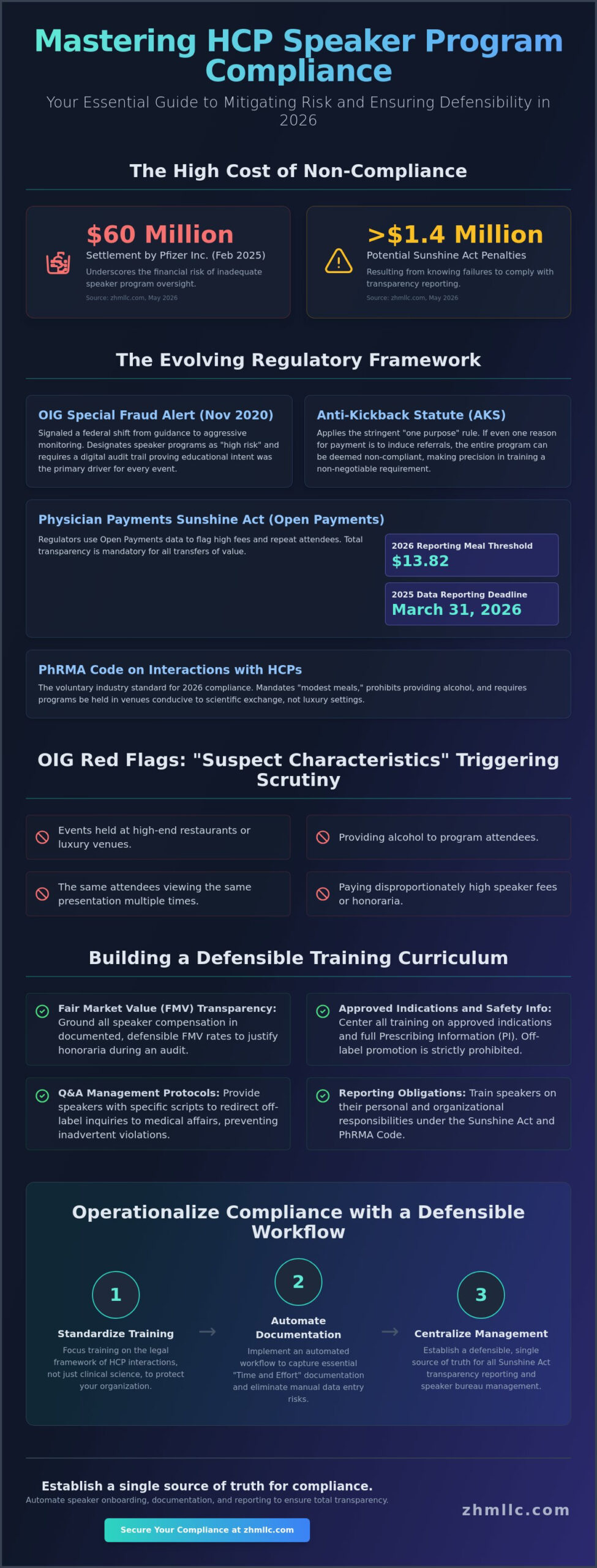
A February 2025 settlement involving Pfizer Inc. for $60 million serves as a stark reminder of the financial stakes tied to speaker program oversight. If you feel the weight of OIG Special Fraud Alerts or struggle with the manual tracking of speaker attestations, you’re not alone. The federal shift toward punitive enforcement means that traditional, fragmented methods are no longer defensible. Implementing robust compliance training for HCP speakers is the only way to ensure your scientific messaging remains consistent while neutralizing regulatory risk.
We understand that the complexity of the Physician Payments Sunshine Act, which includes a $13.82 meal threshold for the 2026 reporting cycle, creates significant operational friction. This guide will show you how to design and execute a speaker training program that satisfies OIG scrutiny and ensures total transparency. We’ll outline a repeatable, defensible workflow that automates documentation and keeps your organization prepared for the March 31, 2026, reporting deadline.
Key Takeaways
- Align your speaker programs with the 2020 OIG Special Fraud Alert to ensure every interaction meets the high standard of documented educational intent.
- Develop a curriculum for compliance training for HCP speakers that prioritizes approved indications and Fair Market Value transparency to satisfy current regulatory scrutiny.
- Implement an automated five-step workflow to capture essential “Time and Effort” documentation and eliminate the risks associated with manual data entry.
- Focus training on the legal framework of HCP interactions rather than just the clinical science to protect your organization from enforcement actions.
- Centralize bureau management through the Zvent.ai platform to establish a defensible, single source of truth for all Sunshine Act transparency reporting.
The Regulatory Framework: Why HCP Speaker Training is a 2026 Priority
Effective compliance training for HCP speakers is the mandatory educational framework that ensures every member of a speaker bureau delivers approved, non-promotional, and scientifically accurate content. In 2026, this process is no longer a simple checkbox. It serves as a critical defensive barrier against the Anti-Kickback Statute (AKS). Federal regulators apply the “one purpose” rule, meaning that if even one reason for a payment to a physician is to induce or reward referrals, the entire program may be deemed non-compliant. This creates a direct nexus between speaker remuneration and federal law, making precision in training a non-negotiable operational requirement.
The foundational text for current enforcement remains the November 2020 OIG Special Fraud Alert on Speaker Programs. This document signaled a shift from educational guidance to aggressive monitoring. By 2026, the Office of Inspector General (OIG) has expanded its scrutiny to include sophisticated data analytics. Regulators now use Open Payments data to flag organizations with disproportionately high fees or frequent repeat attendees. To remain defensible, companies must maintain comprehensive digital audit trails for every interaction, proving that educational intent was the primary driver of the event.
The Role of the PhRMA Code
The PhRMA Code on Interactions with Healthcare Professionals serves as the voluntary industry standard that most organizations adopt as their internal policy. Although voluntary, the 2022 update remains the benchmark for 2026 compliance. It requires signatory companies to provide annual certifications of their compliance programs, reinforcing the need for regular training updates. One of its most significant provisions is the strict distinction between “modest meals” and “remuneration.” For the 2026 reporting cycle, the Physician Payments Sunshine Act threshold for meals is $13.82 per instance. The code explicitly prohibits providing alcohol and mandates that programs occur in venues conducive to scientific exchange rather than luxury settings.
OIG Special Fraud Alerts and Enforcement Trends
The OIG views speaker programs as “high risk” because they involve high-dollar transfers of value to individuals in a position to prescribe products. Investigations often trigger when programs exhibit “suspect characteristics,” such as holding events at high-end restaurants or allowing the same attendees to view the same presentation multiple times. These patterns suggest that the program’s intent is social or financial rather than educational.
The financial consequences of failure are substantial. A February 2025 settlement involving Pfizer Inc. for $60 million related to speaker program non-compliance underscores the risks of inadequate oversight (Source: zhmllc.com, May 2026). Additionally, knowing failures to comply with Sunshine Act reporting can result in penalties exceeding $1.4 million (Source: zhmllc.com, May 2026). Organizations must ensure their curriculum for compliance training for HCP speakers addresses these specific enforcement trends to mitigate the risk of civil monetary penalties and long-term reputational damage.
Building a Compliant Training Curriculum: Core Content Requirements
Developing a robust curriculum for compliance training for HCP speakers requires a shift from clinical education to regulatory risk management. Your training must explicitly establish that all speaker compensation is grounded in Fair Market Value (FMV) transparency. Documenting these rates is essential to justify honoraria during a federal audit. Every training module must center on the “Approved Indication” and include the full “Safety Information” (PI). Speakers need clear, unambiguous instructions that off-label promotion is strictly prohibited. Even a single deviation can trigger an investigation under the “one purpose” rule.
Managing Q&A sessions is a high-risk area where speakers often inadvertently stray into off-label territory. Training should provide specific scripts for redirecting these inquiries to medical affairs. Beyond these verbal interactions, speakers must understand their reporting obligations under the PhRMA Code and the Physician Payments Sunshine Act. With the March 31, 2026, deadline for 2025 data approaching, speakers must be aware that every meal over $13.82 is tracked and reported publicly. If you need assistance aligning your bureau with these strict standards, you can connect with a compliance expert to review your current curriculum.
Medical and Scientific Accuracy
The Medical, Legal, and Regulatory (MLR) review process must approve every slide before it reaches a speaker. In 2026, the industry standard is “fixed” content. Speakers cannot alter, add, or delete slides from the approved deck. Modern digital platforms now allow for real-time content updates. This ensures that if a safety update occurs, the change propagates across the entire national bureau instantly. This centralized control eliminates the risk of speakers using outdated or unapproved data.
Conduct and Interaction Rules
The OIG identifies “suspect characteristics” in programs where the audience includes non-HCPs or “guests.” Your training must strictly prohibit speakers from inviting family members or non-medical staff. You should also set clear limits on program frequency. Allowing a single speaker to conduct an excessive number of programs can suggest a financial relationship rather than an educational one. Every event requires a documented “Educational Need” assessment. This document justifies why the program exists and why the specific audience requires the information.
How to Operationalize the Training Process: A 5-Step Workflow
Transitioning from regulatory policy to operational execution is where many bureaus face the greatest risk. A manual approach to tracking certifications creates data gaps that federal auditors easily exploit. To protect your organization, you must operationalize compliance training for HCP speakers through a technology-driven workflow. This ensures every stage, from initial selection to final payment, generates a verifiable digital audit trail. This level of precision is necessary to align with the OIG Special Fraud Alert on Speaker Programs, which emphasizes the need for substantive educational intent over social or financial inducements.
A defensible audit file requires more than just a signed contract. It must include proof of training, verified attestations, and “Time and Effort” documentation that justifies the honoraria paid. By automating these triggers, you ensure that 100% of your active speakers have met every compliance milestone before they ever step in front of an audience. This “compliance by design” philosophy removes the burden of manual oversight and reduces your regulatory risk profile.
Step 1: Speaker Selection and FMV Contracting
Selection must rely on objective criteria such as therapeutic expertise, board certifications, and geographic need rather than prescription volume or historical loyalty. Establishing Fair Market Value (FMV) tiers based on HCP specialty and years of experience is essential for maintaining a defensible bureau. ZHM LLC manages the full contracting lifecycle, ensuring that FMV caps and debarment screenings are integrated into the agreement before any training begins. This proactive screening prevents the onboarding of high-risk individuals who could trigger OIG scrutiny.
Step 2: Content Delivery and Attestation
Virtual training modules are the preferred promotional channel for 91% of HCPs in 2026. These modules allow speakers to complete requirements on their own schedules while providing the manufacturer with granular data. It’s not enough for a speaker to simply “view” a deck; you must require a signed digital attestation after the module ends. Your platform should capture digital timestamps to record the exact duration of the session. This documentation proves “meaningful engagement” and serves as primary evidence that the speaker was fully briefed on safety information and off-label prohibitions.
Step 3: Verification and Payment Integration
The final step in a compliant workflow is the automated release of honoraria. By auditing training logs against the master speaker list in real time, you ensure that no unverified speaker receives payment. You should link training completion directly to honoraria payment triggers. This means the system won’t process a disbursement until the attestation is signed and the training duration is verified. Utilizing honoraria management services for automated processing eliminates manual spreadsheet errors and ensures total transparency for the March 31, 2026, Sunshine Act reporting deadline.
Mitigating High-Scrutiny Risks: Beyond the Slide Deck
Many organizations face internal pushback when initiating bureau updates, often hearing the objection that their speakers “already know the science.” This perspective misses the primary goal of modern regulatory alignment. While clinical expertise is a prerequisite, effective compliance training for HCP speakers focuses on the legal framework governing the interaction. It’s not a test of their medical knowledge; it’s an essential briefing on the boundaries of the Anti-Kickback Statute. Without this specific training, speakers may inadvertently create “sham” programs where no substantive information is exchanged, an oversight that federal regulators view as a high-risk indicator for illegal inducements.
In 2026, the standard for a defensible program requires meticulous monitoring of every transfer of value. This includes the strict management of “modest meals,” which currently carry a reporting threshold of $13.82 per instance for the 2026 reporting cycle. Regulators use Open Payments data to identify patterns that suggest social rather than educational intent. If your organization cannot prove that every dollar spent was tied to a legitimate educational purpose, you remain vulnerable to civil monetary penalties. If you’re concerned about your current risk profile, you can contact our compliance specialists to evaluate your bureau’s operational safeguards.
Managing Repeat Attendance
Repeat attendance is a primary target for OIG data analytics. Regulators apply the “incremental value” rule, questioning why a healthcare professional would attend the exact same presentation multiple times. Unless a significant update to the safety profile or a new indication has occurred, repeat attendance suggests the program’s purpose is social or financial. To neutralize this risk, you should integrate data analytics that cross-reference attendee lists against historical logs in real time. Automatically flagging and blocking repeat attendees ensures your programs remain focused on genuine clinical education rather than repetitive social interactions.
Venue and Logistics Compliance
Venue selection must prioritize settings that are “conducive to educational exchange.” This requirement prohibits the use of luxury resorts, extravagant restaurants, or venues famous for their entertainment value. According to CMS and OIG guidelines, the setting must not overshadow the scientific content. The 2022 PhRMA Code update reinforces this by explicitly prohibiting any entertainment or recreational activities during or after the program. Your logistics workflow must include a mandatory vetting process for every location to ensure it meets these professional standards. Maintaining a centralized database of pre-approved, compliant venues is the most efficient way to avoid the “suspect characteristics” that trigger federal investigations.
Centralizing Compliance: How Zvent.ai Automates Speaker Onboarding
Relying on manual spreadsheets and fragmented data is no longer a viable strategy for 2026 regulatory alignment. As enforcement models shift toward data-driven scrutiny, organizations must establish a centralized “Single Source of Truth.” The Zvent.ai platform provides this foundational order by integrating speaker bureau management into one automated ecosystem. This centralization eliminates the operational friction of tracking certifications across disparate files. It’s the most efficient way to ensure that every step of compliance training for HCP speakers is recorded, verified, and ready for reporting. Without this level of integration, the risk of data silos can lead to reporting errors that trigger federal investigations.
For lean biotech teams, the platform offers a “pay-as-you-grow” model that provides institutional-grade compliance without the overhead of enterprise-scale software. This scalability allows small organizations to maintain the same level of Open Payments transparency as major pharmaceutical firms. By capturing all interactions in real time, Zvent.ai ensures you meet the March 31, 2026, deadline for Sunshine Act reporting with absolute precision and minimal manual effort. This proactive approach transforms compliance from a reactive burden into a streamlined operational advantage that protects your organization’s reputation.
Automated Compliance Reporting
Zvent.ai captures every transfer of value (TOV) automatically, from meal expenses to honoraria disbursements. This creates an “audit-ready” environment where every interaction is backed by a digital trail of attestations and timestamps. The platform removes the burden of manual data entry, which reduces the risk of the “knowing failures” that can lead to penalties exceeding $1.4 million (Source: zhmllc.com, May 2026). It also simplifies the tracking of the $13.82 meal threshold, ensuring that no instance goes unrecorded. You can view the Zvent.ai platform features to see how these automated workflows neutralize regulatory risk and provide total visibility into your bureau’s spend.
The ZHM “White-Glove” Advantage
While DIY software provides the tools, ZHM LLC provides the strategic architecture needed for complex bureaus. We contrast simple software access with a managed operational support model that serves as a protective layer for your organization. This “white-glove” approach is particularly valuable for small-to-mid pharma companies that lack a dedicated internal compliance department. We act as your seasoned consultants, ensuring that your compliance training for HCP speakers remains current with the latest OIG guidance and PhRMA Code updates. Our team handles the intricate details of HCP contracting and honoraria processing, allowing your team to focus on scientific strategy. Schedule a consultation to modernize your speaker program and secure a repeatable, defensible workflow for the 2026 reporting cycle.
Securing Your Speaker Bureau for the 2026 Regulatory Cycle
Maintaining a defensible speaker bureau requires more than just clinical accuracy. It demands a rigorous commitment to operational transparency. You’ve seen how aligning with the OIG’s foundational guidance involves more than a slide deck review; it requires a repeatable workflow that integrates Fair Market Value contracting with automated documentation. Transitioning away from manual spreadsheets is the only way to ensure your organization meets the March 31, 2026, reporting deadline without the stress of data gaps.
By centralizing your compliance training for HCP speakers through a single source of truth, you eliminate the risks that lead to Sunshine Act reporting errors. Our proprietary Zvent.ai platform provides real-time compliance tracking and specialized support tailored for small to mid-sized life sciences teams. This technology-driven approach ensures your bureau remains scalable and audit-ready as federal scrutiny intensifies. Streamline your HCP compliance with Zvent.ai and gain the peace of mind that comes with precision-engineered oversight. You’ve built a strong scientific foundation; now it’s time to secure it with a professional compliance architecture.
Frequently Asked Questions
How often do HCP speakers need to undergo compliance training?
HCP speakers should undergo training at least once per year or whenever there is a significant update to the product’s safety profile or approved indications. The PhRMA Code requires signatory companies to provide annual certifications of their compliance programs. Regular training ensures that all bureau members remain current on the strict legal boundaries governing clinical messaging and federal interaction rules.
Does the Sunshine Act require reporting of speaker training time?
Yes, any honoraria paid for the time spent completing compliance training for HCP speakers must be reported as a transfer of value. If the speaker receives a fee for the duration of the training session, it falls under the Physician Payments Sunshine Act transparency requirements. Organizations must maintain precise digital timestamps to justify the “Time and Effort” associated with these specific payments.
What are the penalties for non-compliant HCP speaker programs?
Non-compliance can trigger Civil Monetary Penalties (CMPs) and treble damages under the Anti-Kickback Statute. Knowing failures to report transfers of value can result in fines exceeding $1.4 million per year. Beyond financial loss, the government may impose Corporate Integrity Agreements (CIAs) that require years of mandatory federal oversight and expensive independent auditing of all promotional activities.
Can we provide modest meals during a virtual speaker training session?
No, providing or paying for meals during virtual training sessions is generally considered non-compliant under the 2022 PhRMA Code updates. Meals must be provided in a professional setting where the speaker is physically present with the audience. Virtual gift cards or meal delivery for remote participants are viewed as suspect inducements that lack a legitimate educational nexus.
What constitutes Fair Market Value for HCP speaker honoraria in 2026?
Fair Market Value (FMV) is determined through a structured methodology that accounts for an HCP’s specialty, clinical experience, and geographic location. Organizations must use objective, third-party data to establish honoraria tiers. This documentation is essential to prove that payments are for actual services rendered rather than an inducement to reward or influence future prescription volume.
How does the OIG distinguish between a legitimate educational program and a sham event?
The OIG identifies “sham” events by looking for a lack of substantive scientific exchange. Suspect characteristics include high-end venues, the presence of non-HCP guests, and excessive alcohol consumption. A legitimate program must have a documented educational need and a focus on clinical data that justifies the time and effort of both the speaker and the attendees.
Are speakers allowed to use their own slide decks for pharmaceutical programs?
No, speakers are strictly prohibited from using their own slide decks or altering company-provided materials. Every presentation must go through a formal Medical, Legal, and Regulatory (MLR) review process to ensure scientific accuracy and compliance with FDA labeling. Fixed content prevents speakers from making unapproved claims or engaging in prohibited off-label promotion during the event.
What documentation is required to prove a speaker program had educational value?
Proving educational value requires a comprehensive audit file containing a formal needs assessment, the MLR-approved slide deck, and a verified attendee list. You must also include the speaker’s signed attestation and digital logs from the compliance training for HCP speakers. These records demonstrate that the program’s primary purpose was the dissemination of clinical information rather than social or financial inducement.