
Transparency reporting isn’t a post-event administrative task; it’s a data-integrity discipline that must begin the moment an HCP contract is signed. For many compliance teams, pharma event transparency reporting has become a fragmented process of chasing receipts and correcting manual entry errors across multiple vendor platforms. You understand the pressure of maintaining precision under the watchful eye of the Centers for Medicare & Medicaid Services (CMS), especially as state-specific requirements continue to shift. The fear of a CMS audit is a valid concern when your data lives in disconnected spreadsheets.
We agree that your lean team shouldn’t be buried under a mountain of administrative paperwork just to remain compliant with the Sunshine Act. This guide will help you master the complexities of Open Payments by shifting from reactive data collection to a proactive, automated workflow. You’ll learn how to establish a centralized digital environment that ensures data integrity from the start. We’ll outline the essential steps to achieving audit-ready records and reducing the operational friction that typically precedes annual reporting deadlines in 2026.
Key Takeaways
- Understand how the Physician Payments Sunshine Act and the CMS Open Payments program dictate your reporting obligations to ensure full regulatory alignment.
- Transition from fragmented data silos to integrated workflows that eliminate manual entry errors in your pharma event transparency reporting.
- Learn to navigate the complex landscape of state-specific reporting requirements in jurisdictions like Vermont and Massachusetts that go beyond federal mandates.
- Identify “red flag” data patterns and outliers in honoraria spending to prepare your team for the shift toward risk-based CMS audits.
- Discover how combining real-time compliance tracking with white-glove operational support can create a secure, audit-ready environment for lean biotech teams.
The Regulatory Framework: Understanding the Physician Payments Sunshine Act
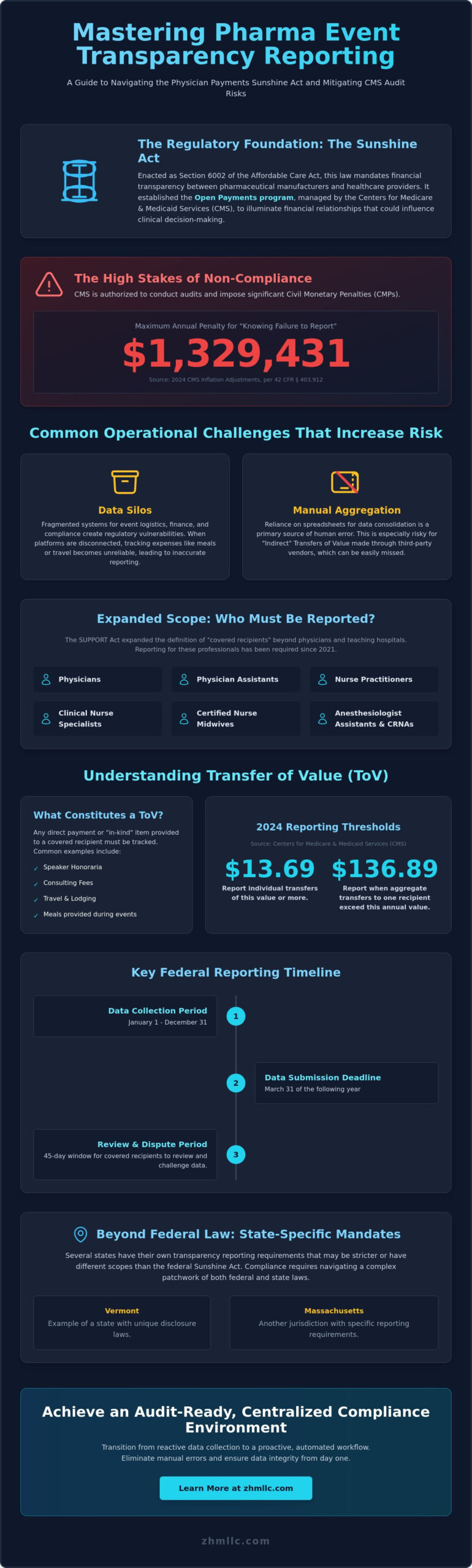
The Physician Payments Sunshine Act, enacted as Section 6002 of the Affordable Care Act, established the first national standard for financial transparency between the pharmaceutical industry and healthcare providers. This law created the Open Payments program, which is managed and enforced by the Centers for Medicare & Medicaid Services (CMS). The primary objective is to shed light on financial relationships that could potentially influence clinical decision-making or research. For compliance officers, pharma event transparency reporting is the mechanism used to fulfill these federal mandates and protect the organization from legal scrutiny.
The role of CMS extends beyond simple data collection. They maintain a public, searchable database that tracks billions of dollars in payments and transfers of value. CMS has the authority to audit manufacturers and impose Civil Monetary Penalties (CMPs) for non-compliance. Under 42 CFR § 403.912, penalties for “knowing failure to report” are significantly higher than those for accidental omissions. According to 2024 CMS inflation adjustments, the maximum annual penalty for knowing violations is $1,329,431. These financial risks make data integrity a top priority for any pharmaceutical commercial team.
Compliance requires tracking a wider range of “covered recipients” than in previous decades. While the law initially focused on physicians and teaching hospitals, the SUPPORT Act expanded this list starting in 2021. Today, your reporting must include physician assistants, nurse practitioners, clinical nurse specialists, certified registered nurse anesthetists, anesthesiologist assistants, and certified nurse-midwives. This broader scope complicates the data collection process at speaker bureau events and advisory boards. Every interaction with these professionals must be documented with precision to avoid triggering federal inquiries.
The Scope of Transfer of Value (ToV)
CMS defines a Transfer of Value as any payment or other transfer of value made to a covered recipient. This definition encompasses both direct monetary payments and “in-kind” transfers. Common examples in pharma event transparency reporting include speaker honoraria, consulting fees, travel expenses, and even modest meals provided during educational sessions. CMS adjusts the minimum reporting thresholds annually to account for inflation. For the 2024 reporting year, manufacturers must report individual transfers of $13.69 or more, or any aggregate total exceeding $136.89 for a single recipient. Accurate categorization of the “Nature of Payment” is essential, as CMS uses these categories to identify potential outliers in spending patterns.
Annual Reporting Timelines
The federal reporting cycle follows a rigid schedule. The data collection period runs from January 1 to December 31 of each year. Manufacturers must submit their consolidated data to the CMS portal by March 31 of the following year. Once the data is submitted, a 45-day review and dispute window opens for healthcare professionals. During this time, physicians and mid-level practitioners can challenge the accuracy of the reported figures. Resolving these disputes quickly is vital; unresolved conflicts can lead to public “disputed” tags on your data. Missing these deadlines or failing to address disputes is a major red flag for federal regulators and can prompt a deeper investigation into your company’s compliance program.
Operational Challenges in Pharma Event Transparency
Operationalizing pharma event transparency reporting requires more than just a checklist; it demands a unified data strategy. Many organizations struggle with “Data Silos,” where event logistics are managed in one system while financial records reside in another. This fragmentation often leads to significant reporting inaccuracies. When a speaker bureau and a compliance team use disconnected platforms, the risk of missing a meal expense or a travel reimbursement increases. These gaps aren’t just administrative nuisances; they’re regulatory vulnerabilities.
Manual aggregation remains a primary source of risk. Relying on Excel-based workflows introduces human error that can prove costly during a federal audit. These errors often stem from “Indirect” Transfers of Value, where payments are made through third-party vendors such as logistics agencies or travel management companies. The Open Payments program mandates that even if a manufacturer doesn’t pay an HCP directly, the value must be captured if the manufacturer is the ultimate source of the funds. Tracking these indirect flows requires meticulous documentation that spreadsheets simply can’t provide with the necessary level of security.
Maintaining a robust audit trail is the only way to satisfy the burden of proof. CMS requires manufacturers to retain records for at least five years from the date the information is published on the public website. This means your team must archive every meal receipt, flight confirmation, and honoraria contract in a searchable, secure format. If an auditor requests documentation for a speaker program from several years ago, a lean team can’t afford to spend weeks searching through paper files or disconnected email threads.
Legacy Systems vs. Modern Automation
Generic event platforms often fail because they lack pharma-specific compliance metadata. They don’t account for NPI number verification or state-specific spend caps. This results in “Dirty Data,” characterized by NPI mismatches and address inconsistencies. Some industry professionals report that specialized automation significantly reduces the time spent on manual data scrubbing by identifying these errors at the point of entry. Centralized digital environments prevent discrepancies before they reach your final report. If your team is struggling to unify these fragmented workflows, you can connect with a compliance expert to discuss modernizing your process.
Managing HCP Disputes
Inaccurate reporting doesn’t just invite federal scrutiny; it damages relationships with high-value speakers. When a physician sees an incorrect dollar amount on the public portal, it creates a reputational risk for both the practitioner and your brand. Proactive communication is the best defense. Centralized platforms allow you to share spend data with HCPs before the submission window closes. This transparency facilitates faster dispute resolution and ensures your speakers feel protected. By resolving discrepancies early, you maintain the integrity of your pharma event transparency reporting and preserve your professional partnerships.
Beyond Federal Law: The Patchwork of State Transparency Requirements
Federal preemption under the Sunshine Act is often misunderstood by commercial teams. While it prevents states from requiring duplicate reporting of information already captured by the Open Payments Program, it doesn’t stop them from mandating the disclosure of different data points. This creates a complex patchwork where pharma event transparency reporting must satisfy both federal and local triggers simultaneously. States like Vermont, Massachusetts, and Minnesota have established their own rigorous standards that frequently exceed federal requirements in scope and frequency.
The primary challenge lies in how states define “Marketing Expenses” versus “Payments.” While federal law focuses on transfers of value to specific covered recipients, some state laws require companies to report the costs associated with marketing activities, such as the salaries of sales representatives or the production of promotional materials. Additionally, certain cities have introduced their own layers of oversight. Chicago and Washington, D.C., for instance, require pharmaceutical representatives to register and, in some cases, report their interactions with healthcare professionals within city limits. This localized scrutiny means that a single speaker program could trigger three or four different filing requirements depending on the location of the event and the licenses held by the attendees.
Vermont and Massachusetts: The Gold Standards of Rigor
These jurisdictions operate with a high degree of oversight regarding gift bans and disclosure limits. Massachusetts manufacturers must comply with the Pharmaceutical and Medical Device Manufacturer Code of Conduct (PCOC), which includes strict rules on meals and modest refreshments provided outside of a hospital setting. Vermont’s law is even more restrictive, maintaining a near-total ban on most gifts to healthcare providers. For the 2026 reporting cycle, Vermont continues to require the disclosure of all allowed expenditures and samples provided to any Vermont-licensed healthcare professional, regardless of their federal status. These state-level mandates often capture a broader range of recipients than the Sunshine Act, making localized data tracking a necessity for every event.
Integrating State and Federal Data Streams
Managing these disparate requirements requires a “Global Spend” view that unifies every transaction into a single source of truth. Compliance teams must distinguish between federal “Transfer of Value” categories and state “Marketing Expense” definitions to avoid double-reporting while ensuring every local mandate is met. This level of precision is difficult to achieve with manual processes that don’t account for state-specific logic. It’s why many organizations seek a partner that understands the intersection of event logistics and regulatory filings. You can learn more about ZHM LLC’s approach to compliance and how we bridge these data gaps. By automating the identification of state-specific triggers at the point of event execution, you ensure that your pharma event transparency reporting remains accurate across all jurisdictions without increasing the administrative burden on your team.
Preparing for CMS Audits: A Proactive Strategy
CMS has transitioned its oversight strategy from random sampling to a sophisticated, data-driven “Risk-Based Selection” model. This means that entities with unusual spending patterns or frequent data corrections are more likely to face a formal inquiry. To manage pharma event transparency reporting effectively, organizations must look beyond the final submission and scrutinize the underlying data for “Red Flags.” These triggers often include honoraria payments that significantly exceed industry benchmarks or recurring instances of excessive meal spend for specific covered recipients. By identifying these outliers internally, you can address potential compliance gaps before they attract federal attention.
A successful audit defense relies on a centralized “Source of Truth.” The Compliance Officer’s role is to ensure that every entry in the public portal can be traced back to original documentation. However, CMS auditors don’t just look at the numbers; they evaluate the integrity of your collection process. They want to see documented Standard Operating Procedures (SOPs) that prove your team followed a consistent, verifiable methodology. Proving how you collected the data is often as critical as the data itself. If your process is fragmented, even accurate data can be viewed with skepticism during a regulatory review.
Steps to Audit Readiness
Achieving a state of constant audit readiness requires a proactive internal review cycle. Conduct internal “Mock Audits” to identify missing receipts or NPI verification gaps before the annual submission deadline. Every HCP contract and honoraria payment must be linked to a specific Event ID to ensure a clear line of sight from the initial engagement to the final Transfer of Value. Your pharma event transparency reporting workflow must maintain a comprehensive audit trail that logs every data modification, including who made the change and when it occurred. This level of granular detail is indispensable when defending your records against CMS scrutiny.
Responding to a CMS Inquiry
The arrival of a “Notice of Intent to Audit” starts a critical timeline for your organization. CMS typically requires a prompt response; having a designated point of contact for all regulatory research is essential to avoid providing conflicting information. You must be prepared to provide detailed data exports and the supporting documentation for specific reporting years. ZHM LLC supports clients through this high-pressure process by providing verified data exports and comprehensive reporting histories that simplify the auditor’s review. If you’re concerned about your current level of audit preparedness, you can schedule a compliance consultation to review your data integrity protocols.
Leveraging Zvent.ai for Enterprise-Grade Transparency
Small and mid-sized biotech teams often face a significant disadvantage in the compliance arena. While global pharmaceutical giants maintain massive internal departments dedicated to regulatory filings, emerging firms must manage the same CMS requirements with lean operations. Zvent.ai levels this playing field by integrating pharma event transparency reporting directly into the event execution workflow. Instead of treating compliance as a separate, retroactive task, our platform captures data the moment an HCP interaction occurs. This proactive approach ensures that your data integrity is baked into the process from the start.
Our solution provides more than just a digital interface; it delivers white-glove operational support designed for teams that value efficiency. We understand that your focus should remain on clinical milestones and commercial strategy, not on chasing missing NPI numbers or reconciling travel receipts. Zvent.ai scales with your organization, offering a pay-as-you-grow model that supports everything from your first 10 speaker programs to a national bureau of 1,000 events. This flexibility allows emerging pharma companies to access enterprise-grade transparency tools without the overhead of traditional legacy systems.
Automating the Honoraria and Spend Lifecycle
Zvent.ai captures Transfer of Value (ToV) data at the primary source. Whether it’s digital meal sign-in sheets or automated travel bookings, every dollar spent is logged and categorized in real-time. This level of automation allows for active budget tracking, which helps prevent threshold violations before they happen. By setting pre-defined spend caps within the platform, you can ensure that honoraria and meal expenses stay within compliant limits. If you’re ready to modernize your bureau operations, you can view our pricing for managed speaker bureau services to see how we fit your specific scale.
The Future of Transparency: AI and Predictive Compliance
The next evolution of pharma event transparency reporting lies in predictive compliance. We utilize machine learning to identify anomalies in spend data long before the final submission window opens. These algorithms detect patterns that might trigger a CMS audit, such as honoraria outliers or inconsistent address data. By moving toward a centralized digital environment for all HCP engagements, your team gains a protective layer against operational friction and regulatory risk. You don’t have to navigate these complexities alone. You can streamline your transparency reporting with ZHM LLC and secure your organization’s future in an increasingly regulated market.
Securing Your Compliance Strategy for 2026
Precision in pharma event transparency reporting is no longer just an administrative goal; it is a foundational requirement for long-term operational success. By moving beyond manual entry and fragmented data silos, your team can transform a complex regulatory burden into a streamlined, audit-ready workflow. This guide has detailed the importance of mastering both the federal Sunshine Act and the intricate, evolving patchwork of state-level mandates. Achieving this level of accuracy requires a proactive shift from reactive data collection to a centralized digital environment where data integrity is prioritized at the source.
Success in this strict legal landscape depends on having the right architecture and expertise in place. With decades of experience in US pharma regulation and our proprietary Zvent.ai platform, ZHM LLC provides the enterprise-grade compliance reporting you need to stay protected against CMS audits. You don’t have to manage these fragmented requirements alone or risk the significant penalties of non-compliance. We invite you to Request a Demo of Zvent.ai for Compliant Reporting and take the first step toward total data integrity. Building a reliable, automated foundation today ensures your team remains agile and compliant for years to come.
Frequently Asked Questions
What is the current reporting threshold for the Sunshine Act in 2026?
CMS adjusts reporting thresholds annually based on the Consumer Price Index for All Urban Consumers (CPI-U). For the 2024 reporting year, the individual item threshold was set at $13.69 and the annual aggregate threshold at $136.89. Manufacturers should monitor the CMS Open Payments portal each October for the updated values that will apply to the 2026 data collection cycle.
How does pharma event transparency reporting differ for virtual vs. in-person events?
Virtual events eliminate the need for tracking physical meal and travel costs but still require reporting for honoraria and consulting fees. Compliance teams must also document the value of any digital educational materials or access codes provided to attendees. In-person events involve more complex pharma event transparency reporting, as they must capture indirect transfers of value through third-party venue and catering vendors.
Are research payments reported differently than speaker honoraria?
Yes, CMS requires research payments to be reported in a separate category from general payments like speaker honoraria. Research reporting must include specific project details, the name of the research institution, and the principal investigator’s information. While honoraria are linked directly to an individual’s service, research payments often involve complex clinical trial agreements that require different data fields in the Open Payments system.
Can HCPs dispute the data reported about them in the Open Payments system?
Healthcare professionals have a dedicated 45-day window each year to review and dispute data before it’s published on the public CMS website. Manufacturers must work to resolve these disputes during this period to ensure the final public record is accurate. If a dispute remains unresolved after the window closes, the entry may be published with a “disputed” tag, which can attract further regulatory attention.
Does the Sunshine Act apply to pharmaceutical companies based outside the US?
The Sunshine Act applies to any “applicable manufacturer” that conducts business in the United States or its territories. If a foreign company has a US-based subsidiary or sells products reimbursed by Medicare or Medicaid, it must comply with federal reporting mandates. These organizations are required to report all transfers of value made to US-licensed healthcare professionals, regardless of where the payment was processed.
What happens if we discover an error in a previous year’s transparency report?
Manufacturers must submit corrected data to CMS as soon as an inaccuracy is identified in a previous year’s report. CMS provides a mechanism for retroactive corrections to maintain the integrity of the public database. Proactive self-correction demonstrates a commitment to compliance and can help mitigate the risk of civil monetary penalties that might arise if the error is discovered during a federal audit.
How do state-level reporting requirements interact with the federal Sunshine Act?
State requirements function as an additional layer of compliance for data points not covered by federal preemption. While the Sunshine Act handles most direct payments to physicians, states like Vermont and Massachusetts often require disclosure of marketing expenses or payments to different recipient types. Manufacturers must maintain a dual-track system to ensure they satisfy both federal mandates and specific local jurisdictional laws simultaneously.
What are the most common reasons for a CMS audit of transparency data?
CMS typically initiates audits based on risk-based triggers such as significant spending outliers or high volumes of HCP disputes. Other common reasons include frequent late submissions, failure to report expanded covered recipient categories, or inconsistencies between internal financial records and public filings. Utilizing a centralized digital environment for your pharma event transparency reporting allows you to identify these red flags internally before they prompt a formal inquiry.