 Demos
Demos  Colors
  Docs
Docs  Support



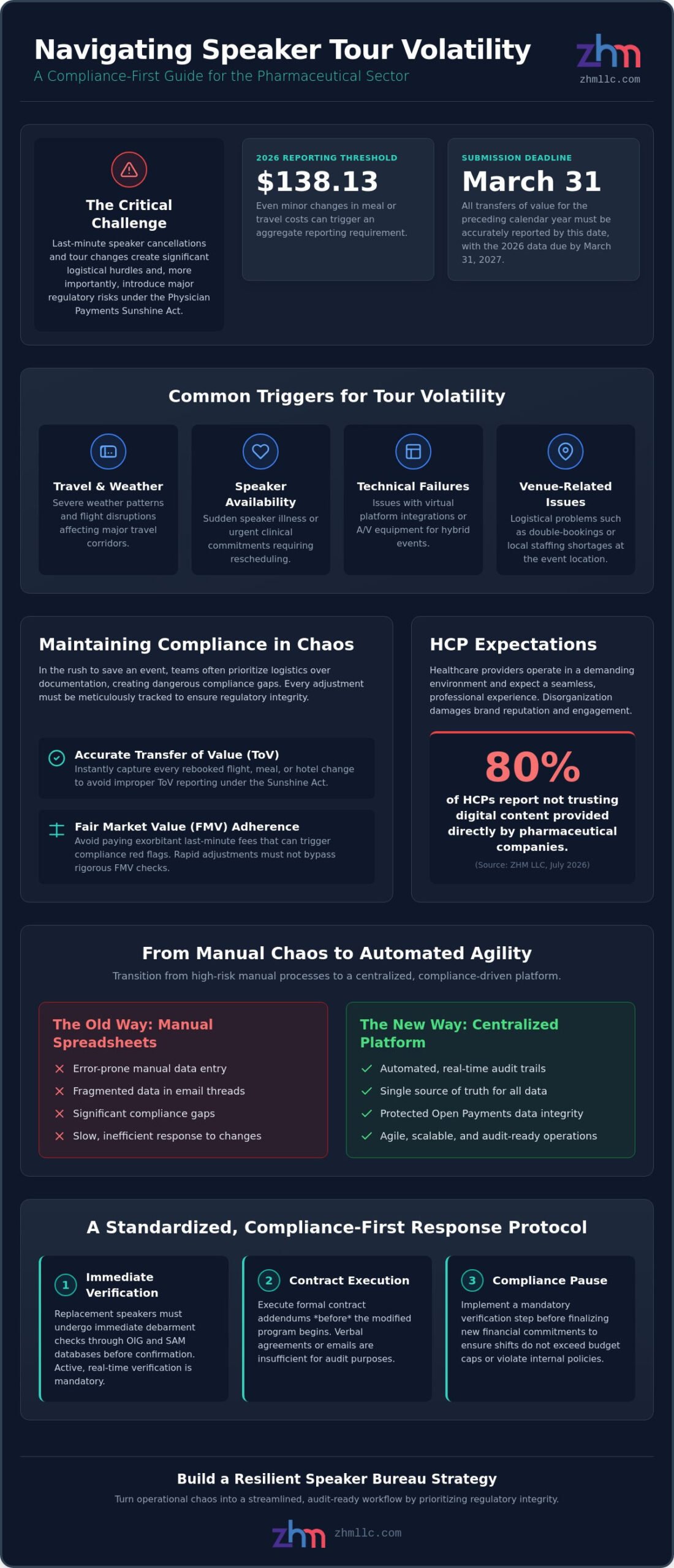
A lead speaker cancels two hours before a dinner program, leaving your team to reconcile travel costs and notify attendees while the clock ticks. In the high-stakes pharmaceutical sector, these disruptions aren’t just logistical hurdles. They represent significant regulatory risks. Managing last-minute changes in speaker tours requires more than just quick thinking. It demands a system that captures every shift in value to ensure your Sunshine Act reporting remains flawless. With the 2026 aggregate reporting threshold set at $138.13, even a small change in meal costs or travel reimbursements can trigger a filing requirement.
We understand that the pressure of a shifting schedule often leads to manual data entry errors and compliance gaps. This guide shows you how to navigate speaker cancellations and schedule shifts while maintaining absolute regulatory integrity. You’ll learn to automate your audit trails and protect the HCP experience, ensuring that every transfer of value is accurately tracked well before the March 31, 2027, submission deadline. We will examine how a compliance-first approach turns operational chaos into a streamlined, audit-ready workflow.
Key Takeaways
- Establish standardized response protocols to verify replacement speakers and execute contract addendums before modified events begin.
- Transition from manual spreadsheets to a centralized platform like Zvent.ai to ensure agility when managing last-minute changes in speaker tours.
- Protect your Open Payments data integrity by capturing every “Transfer of Value” instantly, regardless of schedule volatility or venue shifts.
- Scale your operations by combining expert managed services with automated compliance reporting to minimize the impact of disruptions on the HCP experience.
The Operational Impact of Last-Minute Speaker Tour Changes
Speaker tours are high-stakes environments where volatility is the only constant. Sudden travel delays, weather events, or medical emergencies can dismantle a meticulously planned tour in minutes. When these disruptions occur, the impact ripples through the entire organization. Medical education continuity is broken. The primary objective—delivering critical clinical data to healthcare providers—is stalled.
Managing last-minute changes in speaker tours is a test of a brand’s logistical and regulatory maturity. Poorly handled shifts lead to more than just empty seats. They damage your standing with Key Opinion Leaders (KOLs) who have cleared their schedules to participate. If a program feels disorganized or is canceled without adequate notice, the brand’s reputation for professionalism suffers. A contingency-based speaker program playbook is no longer optional; it’s the baseline requirement for operational success. Maintaining a reputation for professionalism requires the same level of logistical precision found at top-tier entertainment venues like The Vermont Hollywood.
Common triggers for tour volatility include:
- Severe weather patterns disrupting major flight corridors.
- Sudden speaker illness or urgent clinical commitments.
- Technical failures in virtual platform integrations for hybrid events.
- Venue-related issues such as double-bookings or local staffing shortages.
While these triggers focus on professional and organizational risks, they also serve as a reminder of the personal contingencies that speakers and HCPs must manage; for those seeking to secure their financial future despite a complex medical history, check out Special Risk Term to explore specialized life insurance options.
The High Cost of Non-Compliance in Chaos
In the rush to save an event, teams often prioritize logistics over documentation. This creates dangerous gaps. When a speaker is rebooked on a different flight or moved to a new hotel, the financial records must reflect these changes instantly. Every adjustment carries the risk of an improper “Transfer of Value” that could violate the Physician Payments Sunshine Act.
Maintaining Fair Market Value (FMV) standards is particularly difficult under pressure. Paying exorbitant fees for last-minute travel or lodging might solve the immediate problem but can trigger a compliance red flag. You must have systems in place that allow for rapid adjustments without bypassing the rigorous FMV checks established by your legal team.
Stakeholder Expectations in the US Pharma Landscape
HCPs operate in a demanding environment and expect a premium, seamless experience. They don’t see the frantic work happening behind the scenes; they only see the result. If a virtual program fails or a venue changes without notice, their engagement drops. This is especially critical given that 80% of HCPs report they don’t trust digital content provided directly by pharmaceutical companies, according to data from ZHM LLC published in July 2026.
Internal commercial and medical affairs teams also face intense pressure to meet reach and frequency goals. A single canceled tour date can jeopardize quarterly KPIs. Operational resilience is the ability to maintain compliance during unplanned shifts. By prioritizing this resilience, teams can protect the company’s regulatory standing while meeting the high expectations of every stakeholder involved.
Compliance-First Response Protocols for Schedule Shifts
When a schedule shifts, the instinct is to move fast. Speed is necessary, but it shouldn’t bypass your control framework. Managing last-minute changes in speaker tours requires a standardized protocol that prevents regulatory oversights during the scramble. Every replacement speaker must undergo immediate debarment checks through the OIG and SAM databases before they’re confirmed. Relying on a previously vetted status is insufficient; active verification is the only way to ensure compliance in real-time.
Execution of contract addendums must happen before the modified program begins. Verbal agreements or email confirmations don’t suffice during an audit. You need a centralized “Source of Truth” where all logistical and contractual updates are recorded. This prevents fragmented data across multiple email threads. Implement a mandatory “Compliance Pause” before any new financial commitments are finalized. This brief verification step ensures that the shift doesn’t exceed budget caps or violate internal policies.
HCP Contracting and Honoraria Adjustments
Modifying a contract due to a date or venue change requires precise documentation. If a program is partially completed or canceled entirely, honoraria payments must reflect the actual services rendered. Overpaying for a canceled session can be interpreted as an inducement under the Anti-Kickback Statute. The Open Payments Program requires accurate reporting of all transfers of value, including fees paid for canceled events. If you’re unsure how to structure these adjustments, consulting with a compliance expert can clarify your contractual obligations.
Maintaining FMV During Emergency Travel Rebooking
Emergency travel rebooking often results in higher costs. To stay compliant, your policy must define what constitutes a “reasonable” expense during a crisis. If a flight or hotel booking exceeds standard Fair Market Value (FMV) limits, you must document the specific rationale, such as a lack of alternative options within the required timeframe. This documentation is vital for transparency reporting. Additionally, ensure you track “no-show” fees accurately. These fees are often reportable under the Sunshine Act if they’re paid on behalf of the HCP, making real-time data capture essential for maintaining your audit trail.
Leveraging Technology for Real-Time Agility
Manual tracking methods fail when a speaker tour faces sudden volatility. Spreadsheets can’t keep pace with the rapid updates required during a crisis, often leading to data silos and reporting errors. Managing last-minute changes in speaker tours requires a centralized digital platform like Zvent.ai to maintain a single source of truth. This technology enables real-time budget tracking, allowing teams to monitor the financial impact of every change as it happens. Because the 2026 reporting threshold for a single transfer of value is just $13.82, capturing every minor adjustment in travel or meal costs is critical for regulatory compliance.
Centralized Data as a Risk Mitigant
Zvent.ai eliminates the fragmented data problem by consolidating all event details into one accessible environment. This is vital for field-based reps and speakers who need mobile-first access to update program statuses or upload documents on the go. Standardizing digital document collection ensures that receipts and signatures aren’t lost during the chaos of a venue shift. By maintaining a clean digital trail, you can easily reference the CMS Open Payments Program resources to ensure your data meets federal standards. Learn how ZHM LLC streamlines operations by integrating these advanced tools into your existing workflow.
Automated HCP Communication Frameworks
Effective communication is the difference between a saved event and a failed one. Automated frameworks allow you to send instant notifications to HCP attendees regarding venue or time shifts. An emergency HCP notification should always include four essential components: who is speaking, what has changed, why the change occurred, and the specific next steps for the attendee. Utilizing SMS and push notifications is far more effective than email alone for maintaining high attendance rates during disruptions. Automated agility is the rapid, rule-based deployment of event modifications through integrated technology to maintain operational and regulatory continuity. This approach respects the time of the 87% of HCPs who prefer a mix of remote and in-person engagements, according to a Boston Consulting Group survey published in February 2026.
Sunshine Act and Open Payments: Maintaining Data Integrity
Tour volatility directly threatens the accuracy of your annual Open Payments submissions. When a speaker is replaced or a venue changes at the eleventh hour, the financial data associated with that event often becomes fragmented. Managing last-minute changes in speaker tours requires an immediate update to the “Transfer of Value” (ToV) records for all involved parties. For the 2026 calendar year, any single payment of $13.82 or more must be tracked, and once the aggregate annual total of $138.13 is reached, every cent must be reported to CMS. Failing to map these changes to the correct HCP NPI number in real-time creates a reconciliation nightmare that can lead to significant reporting inaccuracies.
Precision is especially critical when handling “Meal No-Shows.” If an HCP confirms attendance but fails to arrive due to a schedule shift, your records must reflect that no value was transferred. Over-reporting benefits to HCPs can lead to disputes during the CMS review period and potentially damage your relationship with key prescribers. Capturing these nuances as they happen ensures your data remains clean and defensible long before the March 31, 2027, data submission deadline.
Audit Readiness in the Face of Volatility
A contemporaneous audit trail is your best defense against regulatory scrutiny. The “reconcile later” approach is a high-risk strategy that often leads to missing receipts and forgotten contractual nuances. You must document every modification to a program as it occurs to comply with the statutory requirements of the Physician Sunshine Act. Real-time tracking allows you to provide a clear rationale for every expense, ensuring that your team is always prepared for an internal or external audit. If you need to scale your compliance infrastructure, you can view our pricing for comprehensive compliance management.
Transparency Reporting for Canceled Events
Canceled events present unique reporting challenges. If a speaker is paid a fee for a program that was canceled within the terms of their contract, that payment is generally still reportable as a transfer of value. However, certain logistical expenses incurred during the cancellation may be non-reportable, provided they aren’t directed to a covered recipient. You must distinguish between these categories with absolute clarity. To ensure your bureau remains compliant through every disruption, request a compliance audit of your speaker bureau to identify and close potential reporting gaps.
Building a Resilient Speaker Bureau Strategy with ZHM LLC
Lean pharmaceutical teams often lack the bandwidth to handle the operational friction of a volatile tour. ZHM LLC acts as a white-glove operational layer, absorbing the stress of managing last-minute changes in speaker tours so your team can focus on medical strategy. By integrating the Zvent.ai platform with high-touch managed services, we provide a unified solution that addresses both the logistical and regulatory demands of modern speaker bureaus. This approach is particularly valuable for emerging biotech firms that require enterprise-grade infrastructure without the overhead of a large internal department.
Our “pay-as-you-grow” model ensures that your compliance and operational support scales alongside your portfolio. This flexibility allows smaller organizations to access the same level of precision and security as top-tier pharmaceutical companies. With the U.S. pharmaceutical market valued at approximately $553.55 billion in 2026, according to ZHM LLC data published in June 2026, the competition for HCP attention is intense. A partner that prioritizes regulatory security ensures your brand remains a trusted source of medical education despite the inevitable disruptions of the field.
Managed Services vs. Software-Only Solutions
Self-service software is a powerful tool, but it can’t navigate a crisis for you. During a major tour disruption, having a dedicated bureau team makes the difference between a saved program and a compliance failure. ZHM manages the full lifecycle of your events, from initial HCP contracting and honoraria processing to final transparency reporting. We bring over 25 years of experience in managing pharmaceutical event friction. This depth of expertise allows us to anticipate risks before they manifest, providing a level of foresight that software-only solutions simply cannot replicate.
Next Steps for Program Optimization
Operational resilience doesn’t happen by accident. It requires a proactive review of your current speaker program contingency plans to identify hidden vulnerabilities. If your team is still relying on manual processes or disconnected tools, the risk of a reporting error remains high. Transition from reactive fire-fighting to proactive program management by choosing a partner that understands the intricate details of this highly regulated sector. Partner with ZHM LLC for end-to-end speaker bureau management to ensure your programs remain compliant, efficient, and impactful.
Strengthening Your Speaker Bureau Resilience
Operational volatility is a constant in the pharmaceutical industry, but it doesn’t have to compromise your regulatory standing. By transitioning from manual spreadsheets to a centralized digital environment, you ensure that every transfer of value is captured as it happens. This real-time visibility is the only way to protect your organization from the reporting inaccuracies that often follow schedule disruptions. Managing last-minute changes in speaker tours becomes a streamlined process when you combine automated agility with a compliance-first mindset.
ZHM LLC provides the specialized support that small-to-mid-sized biotech firms need to maintain enterprise-level infrastructure. With over 25 years of pharmaceutical event expertise and our proprietary Zvent.ai compliance platform, we turn operational friction into a strategic advantage. You can protect your brand’s reputation and ensure flawless Sunshine Act reporting by choosing a partner that understands the intricate details of your field. Streamline your speaker program with ZHM LLC and Zvent.ai to replace reactive fire-fighting with a structured, reliable workflow. We’re here to help you build a more resilient and compliant future for your medical education initiatives.
Frequently Asked Questions
How does a last-minute speaker change affect Sunshine Act reporting?
A last-minute speaker change requires an immediate update to the “Transfer of Value” records to ensure the correct professional is credited with the payment. Any single transfer of $13.82 or more in 2026 must be tracked to maintain federal compliance. Failing to update these records in real-time creates fragmented data that can lead to inaccuracies during the March 31, 2027, data submission deadline.
What are the compliance risks of paying a replacement speaker on short notice?
The primary risks include failing to perform active debarment checks and potentially violating Fair Market Value standards. You must verify the replacement speaker’s status in the OIG and SAM databases before any funds are committed. Without this verification step, you risk making payments to ineligible individuals, which can trigger investigations under the Anti-Kickback Statute.
Can I still report a program as successful if the speaker was changed last minute?
Yes, you can report the program as successful if the medical education objectives were met and all logistical shifts were documented. Success in this context is defined by maintaining operational continuity while ensuring absolute data integrity for transparency reporting. Effectively managing last-minute changes in speaker tours means the attendee experience remains professional despite the internal logistical scramble.
How should honoraria be handled if a speaker cancels due to a travel delay?
Honoraria payments should only be made for services actually rendered or as specifically outlined in the cancellation clause of the executed contract. If a speaker cannot present due to a delay, you must assess if a partial payment is contractually obligated and compliant with Fair Market Value. Overpaying for services not performed can be viewed as a compliance violation by federal regulators.
What documentation is required for emergency HCP travel rebooking?
You must maintain a contemporaneous audit trail that includes the original booking, the specific reason for the emergency change, and the final receipt. If the rebooking cost exceeds standard policy limits, a written rationale explaining the lack of alternative options is required. This documentation proves that the expense was necessary and was not an attempt to provide an excessive benefit to the HCP.
How does Zvent.ai help manage last-minute logistical shifts?
Zvent.ai provides a centralized digital platform that automates budget tracking and attendee notifications during a crisis. It eliminates manual data entry errors by allowing field reps to update program details and upload documents via mobile-first access. This technology ensures that every change is mapped to the correct NPI number, which is essential when managing last-minute changes in speaker tours.
Are “no-show” meals reportable under Open Payments if the speaker cancels?
No, “no-show” meals are generally not reportable if the HCP didn’t consume the meal or receive the benefit. However, you must record the absence accurately to ensure you don’t over-report transfers of value. Precision in recording attendance is vital because the 2026 aggregate reporting threshold is only $138.13 for the entire year, making every individual entry significant.
What is the best way to notify HCP attendees of a venue change?
Utilizing an automated framework that sends SMS and push notifications is the most effective method for immediate communication. These alerts should clearly state the new location, the reason for the shift, and any updated timing. This approach respects the time of the 91% of HCPs who prefer efficient remote or hybrid engagement channels and helps maintain high attendance rates.
Related Posts

Pharma Speaker Program Management: The 2026 Strategic Guide for Life Sciences
With non-knowing Sunshine Act penalties now reaching $216,490 and knowing failures capped at over $1.4…

The Challenges of In-House Speaker Program Management in 2026: A Guide for Life Sciences
According to industry data, settlements related to speaker program allegations from companies like Assertio, Pfizer,…

Virtual Speaker Program Best Practices: A Guide for Life Sciences
If 91% of healthcare professionals now prefer virtual speaker programs, why do so many life…