
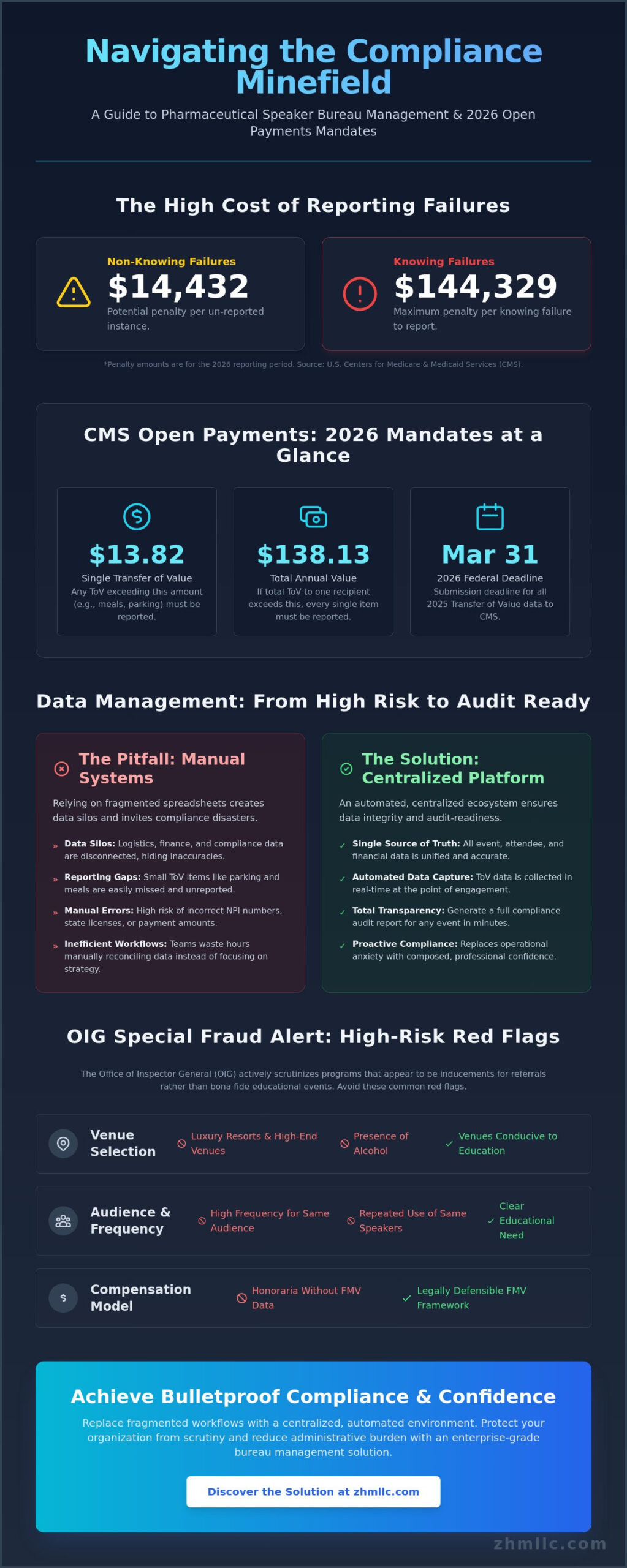
A single reporting oversight in your 2026 Open Payments submission can cost your organization up to $144,329 per instance for knowing failures. For lean pharmaceutical teams, the margin for error has vanished as the CMS mandates reporting for every transfer of value exceeding just $13.82. You likely understand the stress of managing these intricate requirements while relying on manual spreadsheets that inevitably lead to reporting inaccuracies. These common pitfalls in speaker bureau management don’t just create administrative friction; they expose your entire program to federal oversight and OIG scrutiny.
Key Takeaways
- Learn how to capture precise “Transfer of Value” data for small items like meals and parking to ensure total compliance with 2026 CMS reporting mandates.
- Identify and neutralize common pitfalls in speaker bureau management by replacing fragmented manual spreadsheets with a centralized, audit-ready data ecosystem.
- Establish a rigorous, tier-based Fair Market Value framework to protect your organization from OIG scrutiny and ensure all honoraria are legally defensible.
- Optimize the HCP experience by implementing secure, HIPAA-compliant virtual platforms and streamlined logistics that prevent speaker frustration and program cancellations.
- Discover how to leverage the Zvent.ai platform to integrate high-touch service with automated transparency reporting, reducing administrative overhead for lean teams.
Regulatory Pitfalls: Navigating Sunshine Act and OIG Compliance
Regulatory integrity is the bedrock of any successful pharmaceutical speaker program. One of the most significant common pitfalls in speaker bureau management is viewing transparency reporting as a clerical task to be completed after an event concludes. This reactive approach creates a high risk of data gaps. When logistics and compliance are siloed, small yet mandatory “Transfer of Value” (ToV) items like parking fees or modest meals often go unrecorded. These omissions carry heavy consequences. In 2026, even a non-knowing failure to report a single payment can result in penalties of up to $14,432.
CMS requirements are increasingly granular. For the 2026 reporting cycle, any payment or transfer of value exceeding $13.82 per instance must be documented and reported to the CMS Open Payments database. If the total annual value of transfers to a single recipient exceeds $138.13, every individual item must be reported. Relying on manual recall weeks after a program ends is a recipe for non-compliance. Addressing these common pitfalls in speaker bureau management requires a shift from reactive spreadsheets to proactive, automated systems that capture data at the point of engagement.
The Sunshine Act Reporting Gap
Accuracy begins with precise data stewardship of National Provider Identifier (NPI) numbers and state licenses. The Physician Payments Sunshine Act mandates that manufacturers submit their 2025 data to the Open Payments program by March 31, 2026. This federal requirement includes nurse practitioners, physician assistants, and clinical nurse specialists. Beyond federal mandates, some states impose additional aggregate spend limits that require constant monitoring. Failure to track these in real-time can lead to “knowing” failures to report, which carry penalties of up to $144,329 per instance in 2026.
Misinterpreting OIG Special Fraud Alerts
The OIG remains highly critical of speaker programs that function as inducements for referrals rather than bona fide educational exchanges. Following the precedent of the 2020 Special Fraud Alert, the focus has intensified on “modest” meal requirements and “conducive” venues. Programs held at luxury resorts or those involving alcohol are high-risk activities that invite federal oversight. A venue that offers high-end entertainment or recreation is often seen as a red flag, regardless of the quality of the clinical content presented.
Frequency and audience composition are equally vital. Scheduling high-frequency programs for the same audience or using the same speakers repeatedly without a clear educational need suggests a marketing inducement rather than a scientific dialogue. Your bureau should maintain a forensic defense by ensuring all compensation models are backed by rigorous Fair Market Value (FMV) data. This proactive stance ensures your program remains a tool for medical education rather than a liability.
- Does your system automate CMS Open Payments data collection at the point of engagement?
- Do you audit your venue selection process for “luxury” flags before booking?
- Are all “covered recipients,” including mid-level practitioners, integrated into your tracking system?
- Is there a clear process for capturing small ToV items like parking and travel incidentals in real-time?
Data Management Pitfalls: The High Cost of Manual Systems
Fragmented data is a silent killer of compliance. When your logistics team uses one spreadsheet and finance uses another, you create data silos that hide reporting inaccuracies. These inconsistencies often result in duplicate NPI entries or conflicting records of a speaker’s activity. Relying on manual systems is among the most frequent common pitfalls in speaker bureau management. Without a centralized source of truth, your team spends hours reconciling data rather than executing strategy. A robust system should allow you to produce a full compliance audit for any single event in under 10 minutes.
The Spreadsheet Trap in Biotech
Manual entry significantly increases the margin of error for honoraria processing. For lean biotech teams, the difficulty of scaling manual processes during a new product launch can lead to systemic failures. Errors in capturing state license numbers or HCP tiers can trigger red flags during a CMS audit. The team at ZHM LLC provides expert-led data oversight to ensure that your database remains clean and audit-ready as you scale. Addressing these common pitfalls in speaker bureau management is essential for maintaining trust with both regulators and healthcare professionals. If you’re struggling with redundant data entry, it’s time to explore automated data integration to protect your program’s integrity.
Version Control and Document Integrity
Regulatory risk isn’t limited to financial data. It also extends to the clinical content presented. The OIG Special Fraud Alert on Speaker Programs emphasizes that these events must serve a bona fide educational need. This requirement is compromised if speakers use unapproved or outdated slide decks. You must maintain time-stamped approvals for every version of medical content. Modern platforms eliminate this risk by locking content after medical, legal, and regulatory (MLR) approval, ensuring that only the most current, compliant materials are accessible.
- Can you produce a full compliance audit for a single event in under 10 minutes?
- Does your platform lock content immediately after medical/legal approval?
- Are HCP profiles automatically cross-referenced with the NPI registry to prevent duplicates?
- Do you maintain a centralized audit trail for every interaction and document version?
Financial Pitfalls: Honoraria and Fair Market Value (FMV)
Financial mismanagement is a primary trigger for federal investigations. One of the most dangerous common pitfalls in speaker bureau management is compensating healthcare professionals (HCPs) without a rigorous, data-backed Fair Market Value (FMV) framework. The OIG views payments that exceed FMV as potential kickbacks, especially if they appear to induce prescriptions. A detailed analysis of speaker program regulations highlights that remuneration must reflect the actual value of the service provided, not the volume of business an HCP generates.
Maintaining a forensic defense requires more than just a list of rates. You must document the methodology used to arrive at those figures. If your organization negotiates honoraria outside of established ranges to secure a specific “high-value” speaker, you create a significant compliance vulnerability. Every payment must be defensible under audit, which is why centralized financial oversight is non-negotiable for modern pharma teams.
Calculating and Defending FMV Tiers
Defending your compensation model requires a standardized tiering system. You cannot negotiate honoraria rates on a case-by-case basis without risking compliance flags. Tiering should be based on objective criteria such as years of clinical experience, the number of peer-reviewed publications, and the speaker’s professional reach. This structured approach eliminates the subjectivity that often leads to regulatory scrutiny.
| Tier Level | Criteria Summary | Scope of Influence |
|---|---|---|
| Tier 1 | Renowned national expert; extensive publications; board leadership. | National / International |
| Tier 2 | Established regional expert; regular speaker; significant clinical experience. | Regional / State |
| Tier 3 | Local practitioner; respected community peer; meets basic clinical requirements. | Local / Community |
Streamlining the Payment Lifecycle
Operational delays in honoraria processing damage your reputation with key opinion leaders. When payment takes 60 or 90 days, you lose the ability to recruit top-tier talent for future programs. Friction often occurs because attendance verification is disconnected from the finance department. Automating this handoff ensures that once an event is verified, the honoraria process triggers immediately. This reduces disputes and ensures you remain in good standing with your speakers.
Managing these complex financial workflows requires a partner who understands the nuances of HCP contracting. Our pricing models are built to support both emerging biotech and established pharma teams with transparent, value-based management. Beyond honoraria, you must track 1099 reporting requirements for every contracted speaker. Failure to reconcile these payments at year-end creates unnecessary tax and legal exposure that can easily be avoided through centralized data stewardship.
- Is your honoraria process digitally integrated with your attendance verification?
- Do you have a written FMV methodology that is reviewed and updated annually?
- Are all 1099 data points captured during the initial HCP contracting phase?
- Does your system automatically flag any payment requests that fall outside of established tier ranges?
Operational Pitfalls: Logistics and HCP Experience Failures
Logistics serve as the visible face of your speaker program. While earlier sections analyzed the “back-end” risks of data silos and financial compliance, operational failures directly impact your reputation with Key Opinion Leaders (KOLs). Inadequate travel coordination remains one of the most visible common pitfalls in speaker bureau management. When a speaker’s flight is mismanaged or their hotel registration is lost, the resulting frustration often leads to last-minute cancellations. These failures don’t just disrupt a single event; they compromise your ability to secure elite talent for future product launches.
Precision in logistics acts as a protective layer for your brand. If you expect speakers to troubleshoot their own AV or navigate complex travel bookings without support, you’re essentially asking them to absorb your operational friction. This burden often leads to “speaker burnout” and a reluctance to participate in future bureaus. Addressing these common pitfalls in speaker bureau management requires a transition from self-service models to high-touch, concierge-led support that respects the speaker’s time and professional standing.
The Virtual and Hybrid Engagement Gap
The shift toward digital education has fundamentally changed the stakes for operational excellence. Data from the Boston Consulting Group (2022) indicates that 91% of healthcare professionals prefer remote speaker programs for medical education. However, relying on generic meeting software is a significant risk. These platforms often fail to meet the strict HIPAA or security standards required for discussing sensitive clinical data. More importantly, generic tools lack the robust attendance tracking necessary for compliance. You must utilize specialized platforms that capture precise “time in session” for every attendee to ensure your reporting remains audit-ready.
White-Glove Logistics as a Retention Strategy
Operational excellence is your most effective retention strategy for high-value speakers. Many organizations mistakenly believe that “self-service” speaker portals reduce administrative overhead. In reality, these portals often increase the burden on the HCP, leading to lower engagement and higher cancellation rates. Proactive, expert-led travel management ensures that every detail of the speaker’s journey is handled with meticulous care. By providing a dedicated concierge for every engagement, you remove the stress of logistics and allow the speaker to focus entirely on the educational content. If your current logistics model is creating friction for your speakers, schedule a consultation with our operational experts to modernize your HCP experience.
- Do you provide a dedicated concierge for every speaker engagement to handle real-time troubleshooting?
- Does your virtual platform capture “time in session” and verified attendance for all participants?
- Are your travel coordination protocols proactive rather than reactive?
- Has your virtual meeting software been audited for HIPAA and pharmaceutical security standards?
The Solution: Enterprise-Grade Bureau Management with Zvent.ai
Resolving the common pitfalls in speaker bureau management requires more than just a software subscription. It demands an integrated approach that pairs high-level industry expertise with a centralized digital environment. ZHM LLC delivers this through a unique synergy of white-glove service and the proprietary Zvent.ai platform. By centralizing the full program lifecycle, your team can move from HCP contracting to Sunshine Act reporting without the friction of manual data handoffs or spreadsheet errors. This unified system acts as a protective layer, ensuring your operations remain compliant while reducing the administrative burden on your staff.
Many organizations struggle because they partner with technology providers who lack operational depth, or agencies that lack a robust tech stack. You must evaluate if your current partner offers both the technology and the dedicated operational staff required to handle the intricate details of a highly regulated field. This dual-layered protection ensures that every interaction is both logistically flawless and fully compliant with federal standards. When your technology and human expertise are in perfect alignment, you eliminate the reporting inaccuracies that often lead to CMS penalties.
Modernizing Engagement with Zvent.ai
General event platforms aren’t built for the forensic requirements of the pharmaceutical industry. Zvent.ai is a specialized ecosystem designed specifically for Life Sciences, offering real-time budget tracking and proactive compliance oversight. It ensures that every transfer of value is captured at the source, eliminating the reporting gaps discussed in previous sections. You can explore a platform demo at the ZHM LLC homepage to see how automated data stewardship simplifies CMS Open Payments submissions and honoraria processing.
Scalability for Small and Mid-Sized Teams
Lean biotech teams often find themselves trapped between inadequate manual systems and bloated legacy enterprise software. ZHM LLC addresses this through a “pay-as-you-grow” model, providing the sophisticated infrastructure of a global pharmaceutical company without the prohibitive overhead. We act as your “quiet expert” partner, managing the complexity of honoraria processing and logistics so your team can focus on strategic medical education. Addressing common pitfalls in speaker bureau management shouldn’t require a massive internal headcount. It’s time to move away from fragmented complexity and toward centralized order. Contact ZHM LLC to audit your speaker bureau management today.
- Does your current partner provide both the technology and the operational staff to manage your bureau?
- Is your platform built specifically for Life Sciences compliance or is it a general event tool?
- Can your system scale via a “pay-as-you-grow” model to match your product launch trajectory?
- Are all contracting, payment, and reporting functions centralized in a single source of truth?
Securing Your Program’s Future for 2026 and Beyond
Navigating the upcoming reporting cycle requires a fundamental shift from reactive logistics to proactive data stewardship. By systematically addressing common pitfalls in speaker bureau management, you protect your organization from the escalating costs of reporting inaccuracies and federal scrutiny. Success in this highly regulated environment depends on moving beyond fragmented spreadsheets to a centralized digital ecosystem. This ensures your program remains a compliant, defensible tool for medical education rather than an operational liability.
ZHM LLC provides the strategic architecture and hands-on execution needed to modernize your HCP engagements. Our proprietary Zvent.ai platform offers compliance-first Sunshine Act reporting and specialized support tailored for the unique needs of small to mid-sized biotech teams. You can eliminate the administrative burden of honoraria processing while ensuring every interaction meets strict Fair Market Value standards. Our quiet expert approach ensures your bureau is audit-ready and operationally seamless at every stage of the lifecycle.
It’s time to replace operational friction with composed, professional confidence. Optimize your speaker program with Zvent.ai and ensure your team is prepared for the challenges of the 2026 landscape. We’re ready to help you build a more resilient and efficient bureau today.
Frequently Asked Questions
What are the most common Sunshine Act reporting errors?
The most frequent errors include inaccurate National Provider Identifier (NPI) data and failing to capture small Transfer of Value items like parking or modest meals. For the 2026 reporting cycle, any payment exceeding $13.82 must be documented and submitted to the CMS Open Payments database. Missing these small entries leads to aggregate spend violations and can trigger non-knowing failure penalties of up to $14,432 per instance.
How is Fair Market Value (FMV) determined for pharma speakers?
FMV is determined using objective, tier-based criteria such as years of clinical experience, specialty, and the number of peer-reviewed publications. You must maintain a forensic defense by documenting this methodology and updating it annually. Negotiating honoraria rates outside of established ranges is a significant risk that suggests an inducement rather than a bona fide educational exchange.
Can a small biotech company afford enterprise-grade speaker bureau software?
Small biotech teams can access enterprise-grade infrastructure through flexible “pay-as-you-grow” models. These models eliminate the high overhead costs associated with legacy systems while providing the same level of regulatory protection. ZHM LLC specializes in providing this scalable technology to help lean teams manage complex bureaus without a large internal headcount.
What are the OIG requirements for meals at speaker programs?
The OIG mandates that meals must be “modest” and provided in a venue conducive to educational exchange. Programs held at luxury resorts, high-end restaurants, or venues involving alcohol and entertainment are viewed as high-risk activities. Following the 2020 Special Fraud Alert, regulators continue to scrutinize programs that lack a clear educational purpose.
How does Zvent.ai handle HCP contracting and honoraria?
Zvent.ai handles the entire lifecycle by integrating attendance verification directly with honoraria processing in a centralized digital environment. Once an event concludes and attendance is verified, the system triggers the payment workflow to ensure HCPs are compensated promptly. This automation removes the manual entry errors that often lead to financial reporting inaccuracies.
What is the difference between a speaker bureau and an event planning agency?
A speaker bureau focuses on regulatory integrity, FMV compliance, and transparency reporting, while an event planning agency primarily handles logistics like catering and room blocks. Effective management requires a partner that provides both. ZHM LLC pairs the Zvent.ai platform with specialized operational staff to manage the entire HCP engagement process from a compliance-first perspective.
How can we improve HCP attendance at virtual speaker programs?
Improving attendance requires utilizing specialized, HIPAA-compliant platforms rather than generic meeting tools. Data from the Boston Consulting Group (2022) indicates that 91% of healthcare professionals prefer remote speaker programs for medical education. Providing dedicated concierge support to troubleshoot AV issues ensures a professional experience that respects the HCP’s time.
Is it better to manage speaker programs in-house or outsource?
Outsourcing to a specialized partner is often the most effective way to avoid common pitfalls in speaker bureau management. Lean pharmaceutical teams frequently lack the bandwidth to manage the complex system integrations and data stewardship required for audit-ready reporting. Partnering with an expert allows your team to focus on clinical strategy while ensuring every event remains fully compliant.