
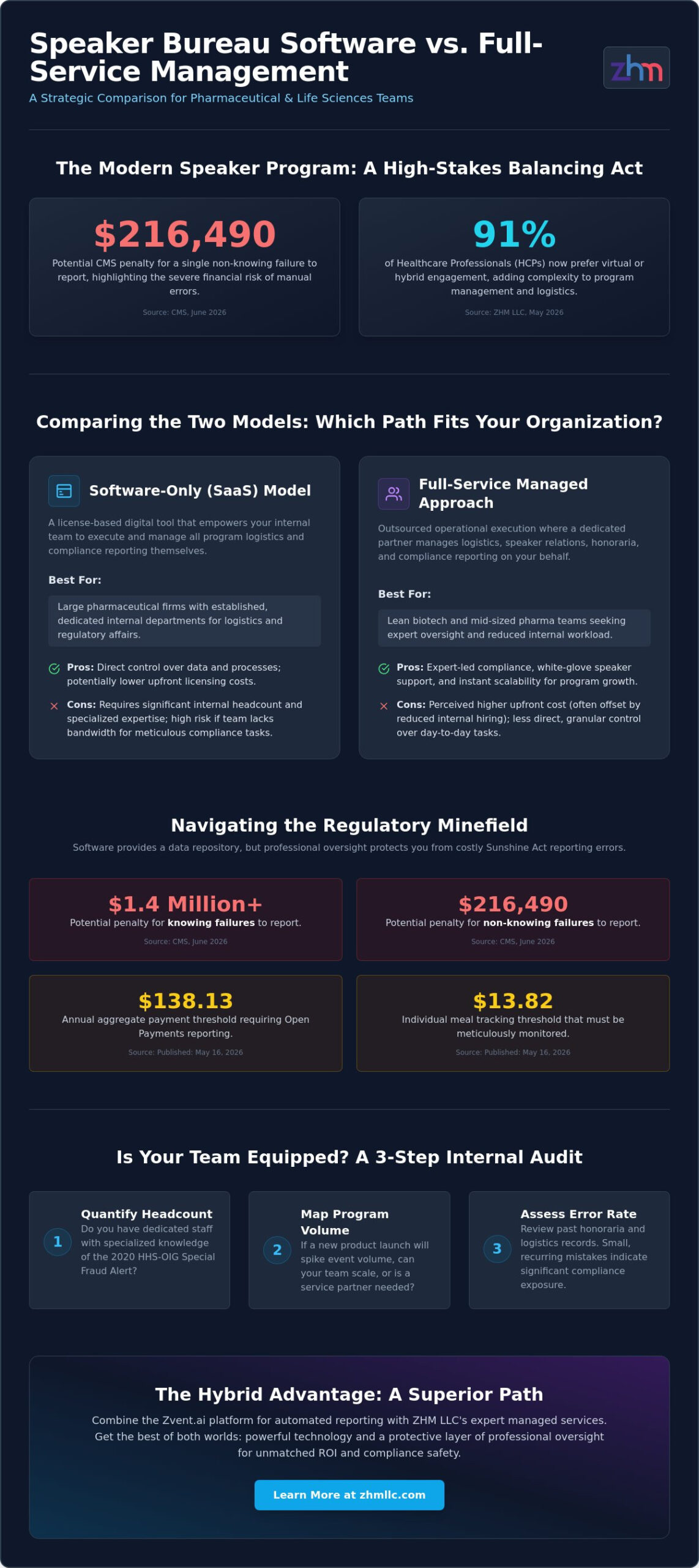
Choosing between speaker bureau software vs full service often feels like a trade-off between control and convenience, but the real stakes involve operational accountability and regulatory safety. Lean teams often find that owning a tool doesn’t stop the manual grind. You’re likely already managing fragmented data while navigating the fear of Sunshine Act non-compliance. With 2026 CMS penalties for non-knowing failures reaching up to $216,490 (CMS, June 2026), the cost of a manual error is simply too high to ignore.
You probably recognize that 91% of healthcare professionals now prefer virtual or hybrid engagement (ZHM LLC, May 2026), making program management more complex than ever. This guide provides a strategic comparison to help you evaluate your internal headcount against these evolving requirements. You’ll learn how to choose a model that automates compliance reporting and delivers a clear ROI. We will break down the differences in support levels, data stewardship, and how to align your choice with the 2020 HHS-OIG Special Fraud Alert guidelines.
Key Takeaways
- Differentiate between license-based digital environments and outsourced operational execution to identify the best fit for your team’s current headcount.
- Use our four-step audit to evaluate your program volume against future growth projections when deciding between speaker bureau software vs full service management.
- Learn why a data repository alone is insufficient for compliance and how professional oversight protects your organization from Sunshine Act reporting errors.
- Establish clear quantitative and qualitative KPIs, focusing on attendance rates and HCP feedback scores, to ensure a measurable ROI on every event.
- Explore the hybrid path that leverages the Zvent.ai platform for automated reporting while utilizing expert managed services to handle complex logistics.
Defining the Landscape: Speaker Bureau Software vs. Full-Service Management
A speaker bureau in the life sciences sector is far more than a roster of experts. It’s a highly regulated mechanism for peer-to-peer education that must withstand intense federal scrutiny. As we move through 2026, the debate over speaker bureau software vs full service has evolved. It’s no longer just about which platform has the better interface. The real question centers on the ownership of the Standard Operating Procedure (SOP). Software provides the “how,” but service provides the “who.”
Organizations must decide if they want to manage a tool or manage an outcome. With CMS penalties for non-knowing failures to report for Open Payments now reaching $216,490 (CMS, June 2026), the margin for error has disappeared. Choosing a model is a strategic decision that affects your team’s daily friction and your company’s legal safety. For many, the choice is between building an internal logistics department or partnering with an expert firm like ZHM LLC to handle the execution.
The Software-Only (SaaS) Model
This model provides license-based access to a centralized digital environment. It’s a tool designed for internal teams to execute their own logistics. Large pharmaceutical firms with established internal departments often choose this path to maintain total granular control over their data and processes.
- Pros: Direct control over data and potentially lower licensing costs compared to full-service fees.
- Cons: Requires significant internal headcount. You need staff to monitor the $13.82 meal tracking threshold for every HCP interaction (Published: May 16, 2026).
If your team lacks the bandwidth to ensure every transaction is reported before the March 31, 2026, deadline, a software-only approach creates a significant compliance gap. The software won’t chase a missing signature or verify a venue’s compliance status; your employees must do that work.
The Full-Service Managed Approach
Lean biotech and mid-sized pharma teams typically find more value in outsourced operational execution. This model includes high-touch logistics, speaker recruitment, and honoraria processing. It moves the burden of execution from your internal marketing or clinical teams to a dedicated partner.
- Pros: Expert-led compliance, white-glove speaker support, and a reduced internal workload.
- Cons: Perceived higher upfront cost, though this is often offset by the reduction in required internal headcount.
The primary advantage is the removal of stress. Professional management ensures that if total payments to a recipient exceed $138.13 in 2026, every cent is captured for Open Payments reporting (Published: May 16, 2026). While the fees might seem higher, they cover the specialized regulatory knowledge required to avoid penalties that can exceed $1.4 million for knowing failures (CMS, June 2026). It’s a shift from buying a product to investing in a protective layer for your organization.
Evaluating Your Capacity: A 4-Step Audit to Choose Your Model
Before selecting between speaker bureau software vs full service, you must audit your operational reality. Many biotech leaders underestimate the manual labor required to maintain speaker program effectiveness. This audit reveals whether your team is equipped for internal management or if outsourcing is a necessity. Use these four steps to baseline your capacity.
- Step 1: Quantify internal headcount. Do you have dedicated staff with specialized regulatory knowledge, specifically regarding the 2020 HHS-OIG Special Fraud Alert? If compliance is a “side desk” job for your team, you’re at risk.
- Step 2: Map program volume vs. growth. Review your 2026-2027 projections. If you’re launching a new product, your event frequency will spike. Software requires you to hire ahead of that curve, whereas a service partner scales with you instantly.
- Step 3: Assess your error rate. Review your current honoraria processing and logistics records. Small mistakes lead to massive exposure. In 2026, failing to track a single meal over $13.82 triggers a reporting violation (Published: May 16, 2026).
- Step 4: Determine risk tolerance. With settlements from companies like Assertio, Pfizer, and Gilead totaling over $265 million in 2025 (ZHM LLC, June 2026), you must decide if your internal controls are strong enough to prevent similar allegations.
If you’re unsure where your program stands, you can request an operational assessment to identify potential gaps in your current workflow.
Assessing Staffing and Technical Expertise
Internal management often hides costs. The time your team spends on manual data entry or troubleshooting a SaaS platform is time taken from strategic marketing. You must identify if your staff can handle the technical implementation of a standalone tool. If they aren’t tech-forward, adoption will suffer, leading to fragmented data and increased compliance risks. The “hidden cost” is the opportunity cost of high-value employees performing clerical tasks like speaker contracting or travel logistics.
Scaling for Future Growth
Emerging biotech firms need elasticity. A “pay-as-you-grow” model allows you to scale without massive upfront investments in internal departments. While software offers a foundation, a managed service partner provides the human capital to handle spikes in program frequency. This ensures that quality doesn’t decline as your portfolio expands. When evaluating speaker bureau software vs full service, consider if you want to manage a tool or manage a partnership that absorbs the burden of growth for you.
Compliance and Regulatory Risk: Where Software Ends and Service Begins
Software acts as a digital vault for your data, but a vault’s value depends entirely on the accuracy of what’s placed inside. When evaluating speaker bureau software vs full service, you must distinguish between data storage and compliance oversight. Software provides the infrastructure to record transactions, but it cannot verify the underlying intent or the accuracy of the input. A full-service partner provides a protective layer of human expertise that identifies potential red flags before they trigger a federal inquiry.
Establishing Fair Market Value (FMV) is a primary example of this distinction. As of January 1, 2026, a CMS mandate requires organizations to use rigorous, well-documented methodologies for establishing HCP compensation (Published: June 2, 2026). While a platform like Zvent.ai can automate the application of these rates, a managed service ensures your methodology remains defensible during an audit. This active oversight is what separates a simple tool from a comprehensive compliance strategy.
Sunshine Act and Open Payments Accuracy
The CMS Open Payments program demands absolute transparency for all transfers of value. Software alone cannot prevent “transcription errors” that occur during live events. If an HCP’s name is misspelled on a sign-in sheet, software may create a duplicate record or fail to associate the spend with the correct National Provider Identifier (NPI). Full-service teams manually verify this data against official databases to ensure every meal over $13.82 and every payment exceeding the $138.13 aggregate threshold is reported correctly (Published: May 16, 2026). This level of accountability is vital for meeting the March 31, 2026, submission deadline for 2025 data.
Auditing and Transparency Standards
A 100% verifiable audit trail is the only defense against the “suspect characteristics” outlined in the 2020 HHS-OIG Special Fraud Alert. Managed services ensure that every program has documented proof of educational need and attendee relevance. These partners also navigate the complexity of state-level reporting variations in jurisdictions like Vermont and Massachusetts, where requirements often diverge from federal standards. Real-time spend tracking allows your team to see aggregate totals instantly, preventing accidental breaches of internal or state-mandated spend limits. By choosing a managed approach, you’re not just buying software; you’re hiring a team to own the regulatory outcome.
How to Measure Speaker Program Effectiveness Across Both Models
Measuring the success of your peer-to-peer education initiatives requires a multi-dimensional view of performance. Whether you utilize speaker bureau software vs full service management, your data must serve multiple internal stakeholders with competing priorities. Success isn’t just about the number of events held; it’s about the quality of the scientific exchange and the precision of the underlying operations.
To evaluate your program effectively, you must track these four KPI categories:
- Quantitative KPIs: Monitor attendance rates and cost-per-attendee. With 91% of healthcare professionals now preferring virtual or hybrid engagement (ZHM LLC, May 2026), your metrics must distinguish between in-person and remote reach to optimize future spend.
- Qualitative KPIs: Capture speaker performance ratings and HCP feedback scores. This data proves the educational value of the program and helps refine your KOL roster.
- Compliance KPIs: Track your error rates in honoraria processing and the speed of your transparency reporting. Accuracy is the ultimate metric here.
- Operational KPIs: Measure the average time from a program request to execution. High friction in this area often signals a need for more robust managed support.
If your current reporting feels fragmented or delayed, you can schedule a consultation to see how centralized data improves your program’s visibility.
Defining “Effectiveness” for Your Stakeholders
Effectiveness is a relative term. Your commercial teams focus on HCP reach and message pull-through to drive market awareness. Conversely, your compliance teams define success by adherence to SOPs and meeting the March 31 reporting deadline without errors. Medical Affairs looks for the quality of scientific exchange and the strength of KOL relationships. A successful model balances these needs by providing a single source of truth that satisfies every department’s requirements simultaneously.
The Role of Technology in Data Collection
Platforms like Zvent.ai centralize metrics that were previously trapped in disparate emails and spreadsheets. This centralization allows for immediate post-event surveys that measure educational impact while the information is fresh. While software provides the raw exports, full-service partners offer interpretive analytics. They don’t just tell you that attendance is down; they analyze the data to explain why and suggest adjustments to your strategy. This layer of insight is often the deciding factor when choosing between speaker bureau software vs full service providers. Raw data informs you, but interpreted data guides you.
The Hybrid Advantage: Why ZHM LLC and Zvent.ai Offer a Superior Path
The traditional choice between speaker bureau software vs full service presents a false dichotomy that often leaves biotech leaders with either an empty tool or an opaque service. ZHM LLC eliminates this trade-off by providing Zvent.ai, an enterprise-grade platform, paired with elite managed services. This hybrid approach ensures you don’t have to choose between digital efficiency and human accountability. It’s a model designed for the modern regulatory environment where software provides the engine and professional management provides the steering.
Most organizations struggle when they treat technology and operations as separate silos. When you implement Zvent.ai, you aren’t just buying a license; you’re gaining a strategic partner that assumes the burden of execution. This integration is vital for navigating the 2026 reporting cycle, where the cost of a single manual error can lead to significant CMS-adjusted penalties. By combining a centralized digital environment with expert oversight, you create a protective layer that software alone cannot provide.
Zvent.ai: More Than Just a Platform
Zvent.ai serves as the enterprise-grade foundation for your entire program. The platform automates the rigorous methodologies for establishing Fair Market Value (FMV) required by the January 1, 2026, CMS mandate (Published: June 2, 2026). It features integrated contracting and real-time transparency reporting that scales as your organization grows. This foundation is backed by ZHM LLC’s 25+ years of industry expertise, ensuring that your digital environment is built on a deep understanding of pharmaceutical compliance.
Operational Peace of Mind
Mid-sized pharma and lean biotech teams choose ZHM LLC because they need end-to-end operational accountability without increasing their internal headcount. Our team handles the heavy lifting of logistics, from venue sourcing to travel arrangements, while ensuring every data point is audit-ready. We verify that every meal over $13.82 and every aggregate payment exceeding $138.13 is captured with 100% accuracy (Published: May 16, 2026). This meticulous attention to detail ensures you meet the March 31, 2026, deadline for 2025 data submission without the stress of last-minute corrections.
The most effective “software” choice for a high-stakes speaker program is the one that comes with a dedicated team of experts. You gain the scalability of a cloud-based platform and the reliability of a seasoned consultancy. To see how this integrated approach can protect your organization and streamline your HCP engagements, you can contact ZHM LLC for a tailored speaker bureau strategy.
Securing Your Program’s Future with Strategic Oversight
Choosing between speaker bureau software vs full service is no longer about finding a tool; it’s about establishing a resilient compliance infrastructure. Your program’s success depends on moving from fragmented spreadsheets to a centralized, automated environment that protects your organization from regulatory risk. By auditing your internal capacity and mapping your growth projections, you can identify whether your team is equipped to manage the manual burden of logistics or if a managed partnership is required to ensure accountability.
ZHM LLC provides the bridge between technology and execution. Our Zvent.ai platform offers an enterprise-grade compliance foundation for lean teams, while our 25+ years of pharmaceutical speaker program expertise ensures that Sunshine Act and Open Payments mastery is built into every workflow. You don’t have to navigate these complexities alone. We provide the protective layer your organization needs to focus on high-value scientific exchange rather than clerical friction.
Request a Consultation to Streamline Your Speaker Bureau Operations. We look forward to helping you build a scalable, friction-free program that delivers measurable results and total peace of mind.
Frequently Asked Questions
What is the main difference between speaker bureau software and a full-service agency?
The primary distinction lies in operational ownership. Speaker bureau software vs full service models differ because software provides the digital infrastructure while full service provides the professional staff to execute logistics, contracting, and compliance. Software requires your internal team to handle the manual labor; full service moves that burden to an external partner who owns the outcome.
How much does pharmaceutical speaker bureau software typically cost in 2026?
Costs vary based on the level of integration and compliance features required. Enterprise-grade platforms are typically priced via annual licensing fees, while managed service models may include per-program or per-speaker fees. You should evaluate these costs against the potential CMS penalties for non-compliance, which can reach $216,490 for non-knowing failures in 2026 (CMS, June 2, 2026).
Can a small biotech company manage a speaker bureau using only software?
Small biotechs can technically use software-only models, but they often face significant headcount challenges. Internal staff must manage speaker travel, honoraria, and the March 31, 2026, deadline for Open Payments data submission. Most lean teams find that the perceived savings of a software-only approach are erased by the high cost of manual errors and redirected internal resources.
What are the risks of using spreadsheets instead of an integrated speaker bureau platform?
Spreadsheets create fragmented data silos that are highly susceptible to transcription errors. Relying on manual entry increases the risk of missing the $13.82 meal tracking threshold required for 2026 reporting (Published: May 16, 2026). Integrated platforms eliminate these risks by centralizing HCP interactions and automating the audit trail, ensuring every transfer of value is captured accurately for federal submission.
How does the Sunshine Act impact my choice of speaker bureau management model?
The Sunshine Act mandates absolute transparency, making your choice of model a critical risk management decision. Your selected model must ensure that every payment exceeding the $138.13 aggregate threshold for 2026 is reported to CMS (Published: May 16, 2026). With penalties for knowing failures exceeding $1.4 million, your model must prioritize reporting accuracy and verifiable data stewardship above all else.
How long does it take to implement a new speaker bureau management platform?
Implementation timelines typically range from four to twelve weeks depending on the complexity of your data and CRM integration needs. This period includes SOP alignment, user training, and establishing honoraria processing workflows. A structured rollout is necessary to ensure that your compliance reporting mechanisms are legally sound and fully operational before your first program launches.
Is full-service speaker bureau management compliant with PhRMA guidelines?
Professional full-service management is specifically engineered to adhere to PhRMA Code and OIG guidelines. These partners act as a protective layer, ensuring that every speaker program has a documented educational need and follows rigorous Fair Market Value (FMV) methodologies. This model is often more compliant than internal management because it utilizes specialists whose sole focus is maintaining these strict industry standards.
What metrics are most important for measuring speaker program ROI?
ROI is measured through a blend of quantitative reach and qualitative impact. Key metrics include attendance rates, cost-per-attendee, and the quality of scientific exchange captured in post-event surveys. Additionally, operational metrics such as the speed of honoraria processing and the accuracy of transparency reporting are vital for demonstrating the overall effectiveness and compliance of your speaker bureau program.